National Health Insurance, Pension & Lump-Sum Withdrawal in Japan
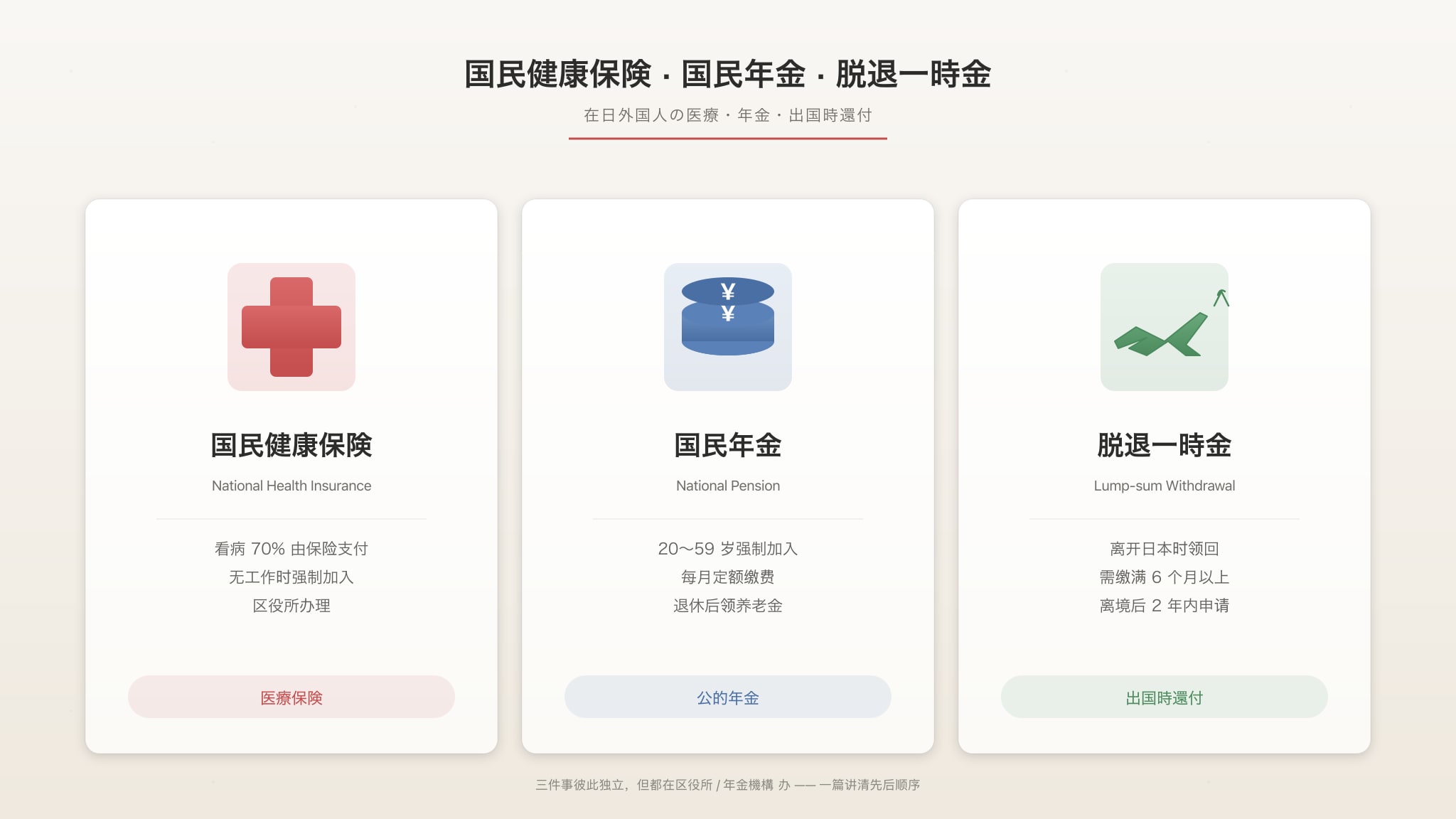
Living in Japan long-term without employer-provided health and pension insurance? You must enrol in two systems yourself: National Health Insurance (Kokumin Kenko Hoken) for medical coverage, and National Pension (Kokumin Nenkin) for retirement. When you leave Japan permanently, you can claim part of what you paid in — the Lump-sum Withdrawal Payment (Dattai Ichijikin). This guide covers all three.
📅 Page verified: September 2026📋 At a glance
| System | Who | Covers | If you skip it |
|---|---|---|---|
| National Health Insurance (NHI) | Residents not on employer insurance | Medical costs | Full price at the clinic, plus a fine |
| National Pension | Residents aged 20–59 | Basic retirement pension | No pension later, plus back-collected premiums |
| Lump-sum Withdrawal | Foreigners leaving Japan | Refund of National Pension paid | Auto-forfeit if you don't claim |
* All three are tied to residence status + jūminhyō (resident registration), not nationality. As a mid/long-term resident, you are generally required to enrol.
⚠️ Skipping NHI = no coverage AND a violation
Any resident (except short-stay visa holders) without employer insurance must join NHI within 14 days. Otherwise you pay full price at the hospital and risk penalty fees. NHI also includes a one-off maternity allowance (around ¥500,000) and funeral benefits.
🏥 National Health Insurance (Kokumin Kenko Hoken): 70% covered
Who must enrol?
- Anyone with a jūminhyō (residence registration) excluding short-stay visas
- Not on employer health insurance — e.g. between jobs, self-employed, students whose part-time work doesn't qualify for shakai hoken, retirees
- Under 75 years old (75+ goes to the separate Late-Stage Elderly system)
International students with a 資格外活動 (part-time work) permit but no employer insurance are usually required to enrol. Follow your school's guidance.
Where and what to bring?
- Counter: National Health Insurance desk (国民健康保険課) at your local city/ward office (区役所/市役所)
- Documents (typical):
- Residence Card (在留カード)
- Passport
- Hanko / personal seal (often useful, not always required)
- Resignation letter (退职证明) if you recently left a job
- My Number card or notification card (optional but speeds things up)
- What you get: a paper 保険証 (insurance card) — bring this to every clinic visit
How the premium is calculated
Premiums are set by each municipality — no national standard. The formula is roughly:
- Income-based (所得割) — on last year's income (often ¥0 for students)
- Per-head (均等割) — a flat amount per insured person
- Per-household (平等割) — in some cities
Rough numbers for students: income ¥0–1.5M, annual premium about ¥15,000–¥40,000 (~¥1,000–¥3,500/month). Always check your municipal notice for the exact amount.
📌 Students usually qualify for a reduction
Many municipalities give students 50–70% off — but you have to apply yourself. Ask about 「留学生減額」 at the counter, or submit a 在学証明書 afterwards for a partial refund.
How it works at the clinic
- Show your 保険証 at any "insurance-covered" clinic/hospital (almost all are). You pay only 30% of the bill (different rates apply under 6 and 70–74).
- High-cost medical care benefit (高額療養費): if a month's bill exceeds a ceiling (varies by income), the excess is refunded after you pay. Don't skip treatment thinking it's too expensive.
- Birth allowance: ~¥500,000 one-off for childbirth (figure changes — verify current policy)
- Funeral benefit (葬祭費): paid to the family of a deceased insured person
📍 Enrol at your local ward office
NHI is the same counter as jūminhyō registration, address changes, and hanko. First visit? The ward-office guide covers the workflow and common paperwork.
📑 National Pension (Kokumin Nenkin): monthly premiums, monthly pension later
Who must enrol?
- Residents aged 20–59 with a jūminhyō
- Not already covered by Kōsei Nenkin (employee pension) at work — full-time employees are auto-enrolled
Three insured categories
| Category | Who | How you pay |
|---|---|---|
| Category 1 | Self-employed, students, job-seekers | Pay directly to the city/ward office |
| Category 2 | Employees covered by Kōsei Nenkin | Auto-deducted from salary |
| Category 3 | Spouse of a Category 2 (income ≤ ~¥1.3M) | Paid by the spouse's Kōsei Nenkin |
How much is the premium?
National Pension is a flat rate, the same nationwide. It is revised each April — check the latest announcement. Recent levels:
- FY 2024: ¥16,980 / month
- FY 2025: ¥17,510 / month
- FY 2026: TBA (typically +¥500 each year)
Student special payment (学生納付特例): students with low income can apply to skip premium payments while still keeping pension credits. Must reapply every year — no retroactive fix if you forget.
Premium exemption (保険料免除): anyone with low income can apply for full or partial exemption (4 tiers: full / 3/4 / half / 1/4). Exempted periods still count toward your pension record.
What if you don't pay?
- Forced collection: Japan Pension Service sends reminders, then after ~2 years hands it to compulsory collection. Can affect visa renewal and lead to asset seizure.
- Lower or no pension later: unpaid months don't count toward your record.
- 10-year retroactive payment window: you can pay up to 10 years back, with caps and interest.
✈️ Lump-sum Withdrawal Payment (Dattai Ichijikin): get part of it back when you leave
Eligibility (all conditions)
- Enrolled in National Pension (or Kōsei Nenkin) as a foreign national (not Japanese)
- Paid ≥ 6 months of premiums (less = not eligible)
- No longer have Japanese residence (you've left the country)
- Never received Japanese old-age or disability pension
- Apply within 2 years of losing residence
How much do you get?
It's a flat amount per paid month, not a return of actual premiums. The "lump-sum withdrawal rate" is published each year and varies by the number of months paid. Rough numbers:
- 6–11 months paid: about ¥30,000–¥60,000
- 5 years (max 60 months): about ¥500,000 maximum (subject to annual revisions)
* Exact amounts are revised annually. Always check the current year's official figures.
How to apply
- Download the form: from the Japan Pension Service website — 「脱退一時金 請求書」
- Fill in and attach:
- Passport copy (photo page + entry/exit stamp pages)
- jūminhyō removal certificate or proof of departure
- Your basic pension number notification or payment slips
- Bank account info (overseas accounts are fine in most countries)
- Mail to Japan: send to the Pension Service processing centre (address on the form)
- Wait: about 2–6 months after approval
⚠️ One shot. Miss it and it's gone.
2 years is a hard deadline. After leaving Japan, packing and settling back home eat your time. The deadline is easy to blow past. Start gathering the documents one month before departure; post them the day you land home. A proxy can file, but it's more paperwork.
📋 Sequence across a typical stay
- Arrive + register: file 転入届 at the ward office → get your jūminhyō
- Same trip: enrol in NHI (within 14 days)
- Same trip: enrol in National Pension (if you're not Category 2/3)
- Start a job: employer handles Kōsei Nenkin + health insurance → you switch to Category 2
- Quit / lose eligibility: within 5 days, switch back to NHI + National Pension (Cat. 1)
- Leave Japan: file 転出届 + claim the lump-sum withdrawal (within 2 years)
❓ FAQ
What's the difference between NHI and company health insurance?
Both are part of Japan's public medical insurance — same coverage rate at the clinic. The difference is the route and the premium formula. NHI is for residents without an employer; premium depends on last year's income and family size. Company insurance (協会けんぽ / 組合健保) is for employees; premium depends on salary and bonuses.
Do I need NHI on a tourist / business visa?
No. NHI requires jūminhyō, which short-stay visas don't get. Buy a travel medical policy covering Japan instead.
Do international students have to pay National Pension?
Yes — all residents 20–59 with a jūminhyō are required to enrol. Students can apply for the 学生納付特例 to skip payments while keeping credits. You must reapply every year.
Can I get Japanese pension after I leave Japan?
Theoretically yes — you can wait until 65 and keep receiving it. In practice, that requires a social security agreement between Japan and your home country. China and Japan currently have no such agreement, so long-accumulated Japanese pension is effectively inaccessible without the lump-sum withdrawal. That's the whole reason Dattai Ichijikin exists.
I left Japan and forgot to claim — past the 2-year window. Any recourse?
Generally no. The 2-year limit is absolute. Best practice: complete the paperwork before you leave, or ask family to file on your behalf as soon as you land home.
Is the lump-sum payment taxable?
Yes — it's classified as "miscellaneous income" (一時所得) under Japanese tax. Japan Pension Service withholds ~20.42% at source. Whether your home country taxes it further depends on local law; China offers a foreign-income credit, but the paperwork is non-trivial.
Official references: Japan Pension Service ↗ |MHLW — Medical Insurance ↗
Next steps
Ward Office Guide
NHI, National Pension and jūminhyō registration all happen here — a quick orientation for first-time visitors
Highly Skilled Foreign Professional Points
Continuous social-security enrolment feeds into the HSP calculation. Understand how these three systems tie into your visa and PR strategy.