Japan Garbage Sorting Guide
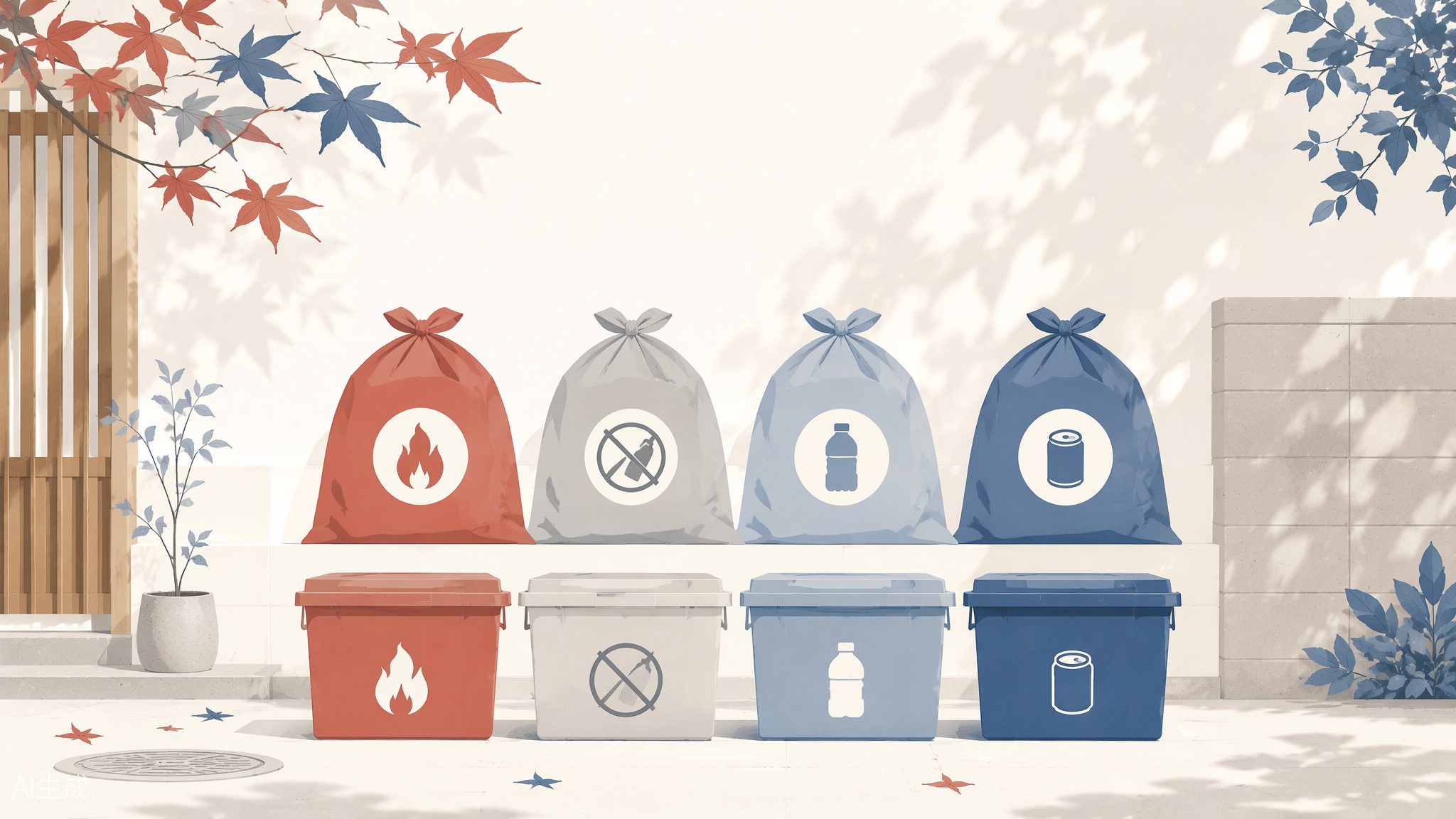
Garbage is where most newcomers in Japan stumble first: sorted wrong — not collected, wrong day — not collected, no sticker — not collected. This guide covers the four categories, commonly confused items, the bulky waste process, and collection rules, all in one place.
📅 Information verified July 2026📋 At a Glance: The Four Categories
| Category | What goes in | Typical frequency* |
|---|---|---|
| Burnable (moeru / kanen gomi) | Kitchen scraps, soiled paper (tissues), diapers, leather & rubber, wood pieces | 2–3× per week |
| Non-burnable (moenai / funen gomi) | Small metal items, glass & ceramics, small appliances, umbrellas | 1–2× per month |
| Recyclables (shigen gomi) | PET bottles, glass bottles, cans, paper, plastic containers & packaging | Weekly or biweekly (by sub-type) |
| Bulky waste (sodai gomi) | Furniture, futons, bicycles — anything over the size limit | By reservation, paid |
* Frequencies are typical patterns only. Category counts and collection days are set by each municipality — always follow your own city/ward's rules.
🔥 Burnable: Not Just "Anything That Burns"
- Kitchen scraps (nama gomi): drain off as much liquid as you can — wet waste smells and is harder to incinerate
- Soiled paper: tissues, paper cups, oil-stained paper (pizza boxes, greasy wrappers) can't be recycled — they're burnable
- Others: disposable diapers (flush solids first), leather goods, rubber, wood pieces (disposable chopsticks, toothpicks)
- In many areas, hard "product plastics" without a recycling mark (buckets, hangers, CDs) are treated as burnable or non-burnable — check your local chart
🔩 Non-Burnable: Small Metal, Glass, Ceramics, Small Appliances
- Metal items: pans, knives, etc. (wrap blades in thick paper and label them 「キケン」/ "dangerous")
- Glass & ceramics: cups, plates, mirrors; wrap broken glass the same way
- Small appliances: hair dryers, electric kettles, etc. (size limits vary — in Tokyo's 23 wards, under 30 cm per side can go out as non-burnable)
- Lighters: must be completely empty
⚠️ Never mix in lithium batteries or power banks
Power banks, e-cigarettes, and rechargeable batteries tossed into regular garbage are a leading cause of fires in collection trucks and processing facilities. Follow your municipality's instructions — many areas have dedicated drop-off boxes for small electronics and batteries (often at electronics stores or supermarket entrances).
♻️ Recyclables: The Most Sub-Categories, the Most Mistakes
PET bottles (pettobotoru)
Three steps: remove the cap → peel off the label → rinse, then crush flat. Caps and labels count as "plastic containers & packaging" and go separately. Only drink bottles qualify as PET; oil and sauce bottles usually don't.
Glass bottles & cans (bin / kan)
Empty and rinse before disposal. Some areas require glass bottles to be separated by color (clear / brown / other). Spray cans must be used up and bagged separately — follow local instructions (some areas require puncturing, others explicitly forbid it).
Paper (koshi)
Newspapers, magazines, cardboard, and milk cartons are sorted by type and tied with paper string (usually not bagged). Break cardboard down flat; rinse, cut open, and dry milk cartons. Oily or smelly paper can't be recycled — it's burnable.
Plastic containers & packaging (pura mark)
Look for the 「プラ」 recycling mark: snack bags, egg cartons, takeout containers, shampoo bottles, supermarket bags, foam trays — rinse clean before disposal. Grease that won't wash off? Straight to burnable. Since the relevant law took effect in April 2022, more municipalities now also accept "product plastics" like hangers and buckets as recyclables.
🤔 The three most-confused items
Takeout containers: pura-marked and washable → plastic recyclables; too dirty → burnable. Pizza boxes: grease-soaked → burnable (tear off clean parts and recycle those). Umbrellas: non-burnable in most areas, no need to disassemble.
🔧 Use as you read: Japan Apartment Guide
Ask about the garbage station and sorting rules before you sign — our renting checklist covers it
🛋️ Bulky Waste: Reservation + Fee
Furniture, futons, bicycles, and anything over the size limit (30 cm per side in Tokyo's 23 wards; some cities use 50 cm — check locally) can't be left at the collection point. Follow the reservation process:
- Reserve: call or book online with your ward's "Bulky Waste Reception Center" (sodai gomi uketsuke senta), state the items and quantity, and confirm the collection day and fee
- Buy disposal stickers: available at convenience stores, supermarkets, or cleaning offices. Tokyo's 23 wards use Sticker A (¥200) and Sticker B (¥300), combined to match the per-item fee; prices and sticker types differ elsewhere — check locally
- Fill in & attach: write your name or reservation number on the sticker and attach it somewhere visible on the item
- Set it out on collection morning: typically near your building's ground-floor entrance or the designated spot — no need to be present
⚠️ These appliances can't go out as bulky waste
Air conditioners, TVs, refrigerators/freezers, and washing machines/dryers are covered by the Home Appliance Recycling Law, and PCs (desktop or laptop) aren't collected by municipalities either. Recycle them through the retailer, an electronics store, or the manufacturer — a recycling fee applies.
🔧 Use as you read: City Office Procedures
Unsure about the rules? Ward offices hand out multilingual sorting guides and answer questions — see the checklist
⏰ Collection Rules: Time, Place, Bags
- Time: set garbage out on collection day before the designated morning time (often 8:00 or 8:30 AM, depending on your area). Most municipalities ban putting it out the night before — crows, fire risk, and odors are the usual reasons (exceptions exist: Fukuoka City collects at night, from sunset to midnight)
- Place: your address has an assigned collection point (gomi station), usually by your building or a fixed spot on the block. Not sure? Ask your landlord, building manager, or ward office
- Bags: many cities require official city-designated bags (sold at convenience stores and supermarkets) or transparent/semi-transparent bags so contents are visible; bags from other cities won't be accepted
- Wrong sort = not collected: mis-sorted, wrong-day, or wrong-bag garbage gets left behind with a warning sticker — take it home, re-sort, and put it out on the next collection day
⚠️ Breaking the rules costs more than a missed pickup
Under the Waste Management and Public Cleansing Law, illegal dumping (fuhou touki) is a crime: individuals face up to 5 years in prison or a fine of up to ¥10 million (both can apply in serious cases), and corporations up to ¥300 million. Leaving bulky waste at a collection point without a sticker can also be treated as illegal dumping.
🗾 Rules Vary by Region — Check Your Own Municipality First
- Japan has no single national sorting standard: within the framework of the Waste Management Act, each municipality sets its own categories, collection days, and bag requirements
- Sorting detail varies widely: some areas get by with 4 categories, while big cities like Yokohama sort into 10 or more
- The same item can be recyclable plastic in Ward A and burnable in City B — relearn the chart every time you move
- Each of Tokyo's 23 wards has its own rules, designated bags, and bulky waste reception center; most municipalities provide multilingual sorting guides (Chinese / English / Korean and more) at the ward office, plus searchable online tools or apps
🙇 Why Japanese People Take Sorting So Seriously
- There's a saying in Japanese: "Mazereba gomi, wakereba shigen" — mixed, it's garbage; separated, it's a resource. One mis-sorted item can contaminate an entire batch of recyclables
- The pressure is real: according to Ministry of the Environment statistics, each person in Japan generates about 890 g of household waste per day, and the country's final disposal sites are estimated to have only around 20 years of capacity left
- Collection points are shared neighborhood spaces, often maintained by residents who take turns cleaning and setting up crow nets. Dumping early or sloppily just pushes the burden onto your neighbors
- For foreigners, following garbage rules is the most visible first step to becoming part of the community — building managers and neighbors notice
❓ FAQ
What happens if I sort something wrong?
Most commonly, your bag gets a warning sticker and is left behind at the collection point. Take it home, re-sort, and put it out on the next collection day. Repeat violations may draw a reminder from your building manager or ward office, but rarely an immediate fine — illegal dumping and sticker-less bulky waste are a different story (see penalties above).
Where can I look up an item I'm unsure about?
Three options: ① your municipality's online "waste sorting search" (type in the item name); ② the multilingual sorting guide at your ward office; ③ official sorting apps some cities provide. When in doubt, calling your ward's cleaning department is the safest bet.
I overslept and missed the collection time — now what?
Take the garbage back home and wait for the next collection day — never just leave it there. "Late garbage" sits at the collection point all day or longer, attracts crows, annoys neighbors, and violates the rules.
Official reference: Ministry of the Environment: waste sorting basics (Japanese) ↗
Next Steps
Ward Office Procedures Guide
Moving-in registration and address changes — plus where to pick up your sorting guide
Japan Apartment Guide
Finding, signing, and moving in — including how to locate your garbage station