🗂️ Topic: Housing (4 guides, in situation order)
Moving House in Japan: Filing the Notices and Updating Everything
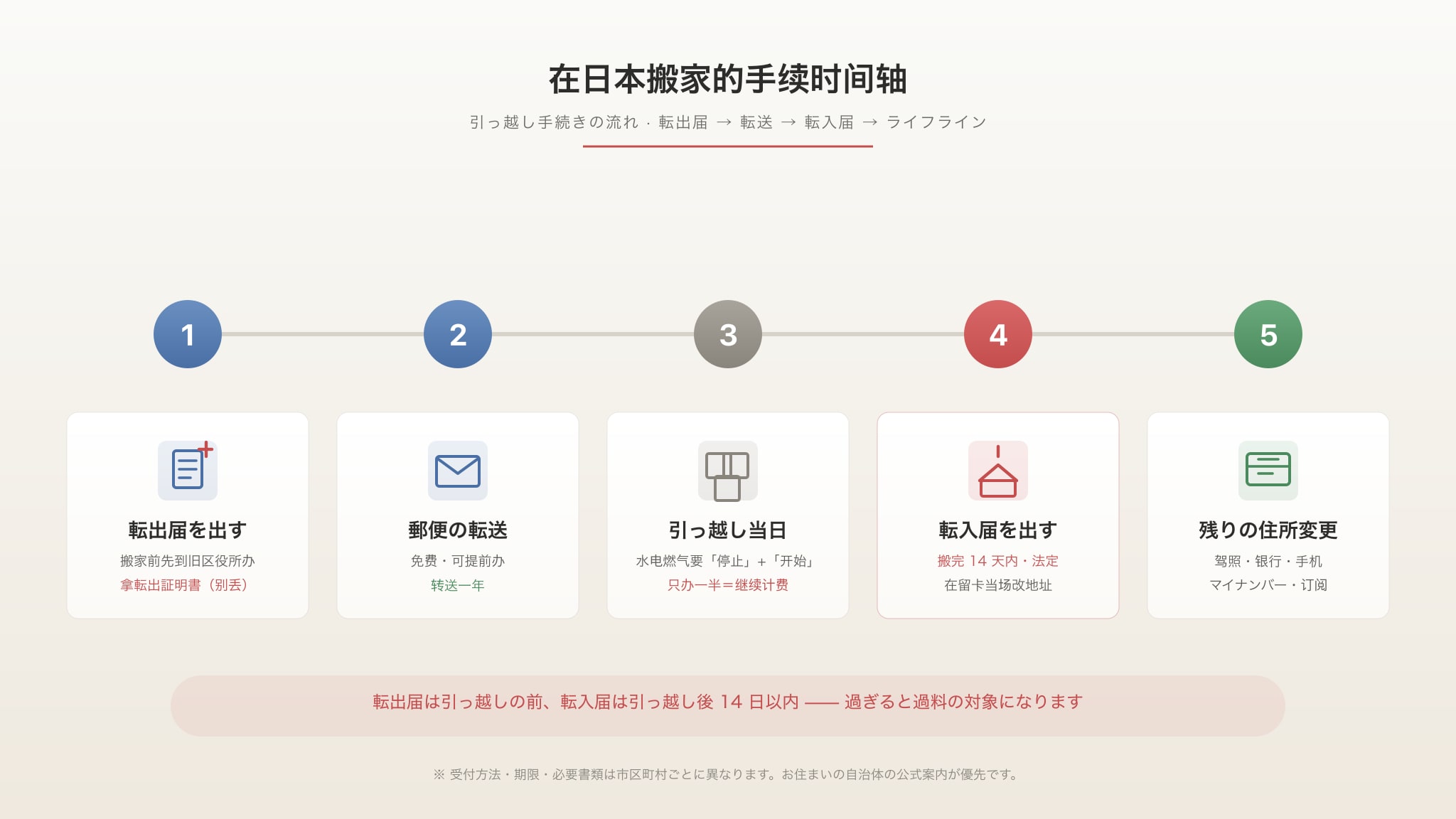
Moving house in Japan is not just carrying boxes. The notice of departure (転出届) has to be filed before you leave, the notice of arrival (転入届) within 14 days after you arrive, and missing either deadline carries a fine. On top of that: mail forwarding, the address on your Residence Card, utility settlements, and health insurance and pension all have their own counters. Here is the whole chain, ordered as a timeline.
📅 Page verified: September 2026It splits into two halves. Before you move, file the 転出届 at your old city office and collect the 転出証明書 (departure certificate). Within 14 days of moving in, file the 転入届 at your new city office — they then print the new address on the back of your Residence Card on the spot, and you transfer your health insurance and pension in the same visit. Both deadlines are legal obligations with a fine attached. Three things people most often forget: mail forwarding at the post office (free, can be filed in advance, lasts a year), cancelling and starting utilities (two separate procedures, billed by actual days used), and updating your driving licence, bank, phone and My Number Card.
📋 At a glance: what to do when
| When | What | Where |
|---|---|---|
| 1–2 months before | Give notice to vacate (退去届) to landlord / management company | Management company or landlord |
| From 2 weeks before | 転出届 → collect the departure certificate (転出証明書) | Old city / ward office |
| From 2 weeks before | 転居届 mail forwarding (can be filed up to a year ahead) | Post office or online |
| 2–3 weeks before | Book utility stop dates at the old place and start dates at the new one | Each utility provider |
| Within 14 days after | 転入届 + Residence Card address + health insurance & pension | New city / ward office |
| Soon after | Driving licence, bank, phone, My Number Card, online shops and subscriptions | Each counter / app |
* Reception windows, required documents and whether you can pre-file online all differ between municipalities. Whatever your new municipality publishes officially is what counts.
🧳 The move, step by step (7 steps)
-
Fix the moving date, then work backwards
Japanese moving admin is a two-ended process. The failure mode is rarely a single hard procedure — it's doing things in the wrong order. People move out before cancelling a utility and pay an extra month; people hand back the old flat before filing the 転出届 and then can't make the deadline.
Fix the date first, then schedule backwards: notice to vacate (1 month minimum) → 転出届 → mail forwarding → utilities → move → 転入届.
-
Give notice to vacate
Your lease states the notice period — commonly one month, sometimes two. Give notice by the method the contract specifies, or you'll be charged an extra month's rent. The contract governs, not what a friend tells you.
Confirm three things at the same time: how the deposit is returned, how restoration costs are calculated, and the date of the final inspection (退去立会). Be there in person and photograph everything.
-
File the 転出届 and collect the certificate
Go to the city office covering your old address. Bring your Residence Card (and My Number Card if you have one). You'll walk out with a 転出証明書 — the certificate you hand over at the next step. Do not lose it.
They'll ask for your new address. If it's settled, give it. If not (say you're in a hotel while house-hunting), you can file with it undecided and sort it out later. Some municipalities accept online or postal pre-filing — check what yours publishes officially.
Do these in the same visit while you're there: leaving National Health Insurance, cancelling your seal registration, changing the address on child allowance (児童手当). Moving is the one moment where everything can be done in a single trip.
-
Set up mail forwarding at the post office
File a 転居届 at any post office and mail sent to the old address is redirected automatically. It's free, can be filed up to a year in advance, and lasts a year. Most people assume you file it after moving — filing it before is what actually protects you, because it catches everything sent during the move itself.
You can do it at a post office counter, online, or by post with the form. Forwarded mail arrives with a redirect sticker — that sticker is your to-do list: change the address with each sender. Banks, cards, phone, subscriptions and the pension service are usually in the pile.
-
Utilities: cancel and start — both, not one
This is where moving quietly costs people money. Stopping service at the old address and starting it at the new one are two separate procedures. Do only one and you keep paying on the other. You're billed for actual days used, not whole months.
Key points: gas must be booked and someone usually has to be home for the connection; electricity and water are simpler but don't skip the name change (名義変更) or the stop request; internet is the slowest of the four and needs a scheduled installation slot.
I've written the booking order, cost structure and the specific traps separately — see the utilities setup guide.
-
Within 14 days of moving in: 転入届 + Residence Card + insurance + pension
Go to the city office covering your new address and file the 転入届. Bring the 転出証明書, your Residence Card, your passport, and your seal (some counters ask).
- Residence Card address: once the resident record is updated, the counter prints the new address on the back of your Residence Card. You do not go to Immigration for this. It's the biggest single difference from how it works for Japanese nationals, and the reason this step matters most for you.
- National Health Insurance: you leave the old municipality's scheme and join the new one; new card issued. Same counter.
- National Pension: address change; if you're 20–60 and liable, new payment slips follow.
- My Number Card: update the printed address on the spot if you brought it. If not, you're given a certificate to take to a later appointment — deadlines for that are set officially.
-
Mop-up: licence, bank, phone, subscriptions
Once the resident record is updated, the rest is just notifications:
- Japanese driving licence: update the address at a police station or licence centre. There is a legal deadline after moving — confirm the current figure officially.
- Bank: change it in the app or at a branch. Note that cards and statements sent to the old address get returned — change first, then wait.
- Phone: update in the carrier app or in store; it ties into identity verification.
- Subscriptions and shops: Amazon, Rakuten, delivery apps, utility billing addresses.
💡 Utilities: setting up, and settling up
Which of the four is slowest, why gas needs an appointment, and how not to pay an extra month when you leave
⏰ How the two 14-day rules actually work
- 転出届 (moving out): filed before you move, within the window of 14 days ahead of your moving date — you can't file it months early. How each municipality accepts it varies; check the official guidance from your old city office.
- 転入届 (moving in): filed within 14 days of arriving, counted from the day you start living at the new address — not the contract date, not the removal van date.
- If you're late: the law provides for a fine. In practice prosecutions are rare, but the late filing is on your record and can come up when you next deal with Immigration. Don't gamble on it.
- Moving abroad is a different procedure (転出届 plus a notification of overseas departure) and these 14-day rules don't apply.
⚠️ The three places people get stuck
① Handing back the old flat before filing 転入 — with no resident record at any address, banks, phone and pension can't be updated. Keep an overlap between the two places, or at minimum get mail forwarding running first. ② Losing the 転出証明書 — you have to go back to the old city office for a replacement, which is painful across prefectures. Photograph it the moment you get it. ③ Cancelling electricity but not gas — gas carries a standing charge even when unused, so ignoring it just accumulates bills.
💴 Costs: what's free, what bites
- 転出届 / 転入届: free. These filings cost nothing.
- 転居届 (mail forwarding): free, for a year.
- Resident record and seal-registration certificates: charged per copy. Prices are set by each municipality — check the official list.
- Utilities: billed for actual days used; there's no separate cancellation fee, but confirm where the final bill will be sent.
- Restoration costs when you leave: usually the biggest single item. The contract and the final inspection decide it. The customary split is that normal wear and tear is the landlord's and negligence is yours, but the specific formula is contractual.
📝 Moving checklist
- Notice to vacate filed (by the contractual deadline)
- 転出届 → certificate collected → photographed as a backup
- Mail forwarding filed; then change the address with each sender as stickers arrive
- Old place: stop electricity, gas, water, internet + confirm the final billing date
- New place: start all four (gas needs someone home)
- Within 14 days: 転入届 + Residence Card + health insurance + pension + My Number
- Driving licence, bank, phone, subscriptions, online shops
- Garbage collection days and sorting rules at the new address — cross a municipal border and the whole system changes
❓ FAQ
I haven't found a new place yet — can I still file the 転出届?
Yes. You can file with the new address undecided, take the certificate, and file the 転入届 within 14 days once you've settled. But be aware the 転出証明書 has an expiry — check the officially stated period — and you'll need a fresh one if you sit on it too long. The safe combination for this gap is to get mail forwarding running first so nothing goes missing.
Do I need a separate trip to Immigration for my Residence Card?
No. Under the Immigration Control Act, the municipal counter prints the new address on the back of your card when your resident record changes. Filing the 転入届 is the Residence Card address change. This is precisely why moving admin matters more for foreign residents than for Japanese nationals: your address and your status of residence are tied together.
Does health insurance and pension transfer automatically between cities?
Not between municipalities. At the same counter as the 転入届, you join the new city's National Health Insurance (the old membership lapses) and change your pension address. Moving within the same municipality is just an address change — no re-enrolment. NHI premiums are calculated per municipality, so premiums change when you cross a city line — worth checking before you commit to a place.
Do the garbage rules really change?
Yes, and by more than people expect. Sorting categories, collection days, designated bags and bulky-waste booking are all set by each municipality. First thing at the new address: get the garbage calendar and sorting chart from the city office or their website. Our garbage guide covers the rules that are common nationwide, but what gets collected outside your door and in which bag is decided by your new municipality.
What happens if I forget to update something?
Two categories. Legally required (resident record, Residence Card, driving licence): a fine, or knock-on trouble with later applications. Commercial (bank, phone, cards, shops): no legal consequence, but important post — immigration renewal paperwork, bank cards, pension notices — goes to the old address. Mail forwarding is the practical safety net for a year, but it isn't a substitute for updating things.
Official references: MIC — moving-in / moving-out notification ↗ |Japan Post — mail forwarding ↗ |Immigration Services Agency — change of address ↗
Next steps
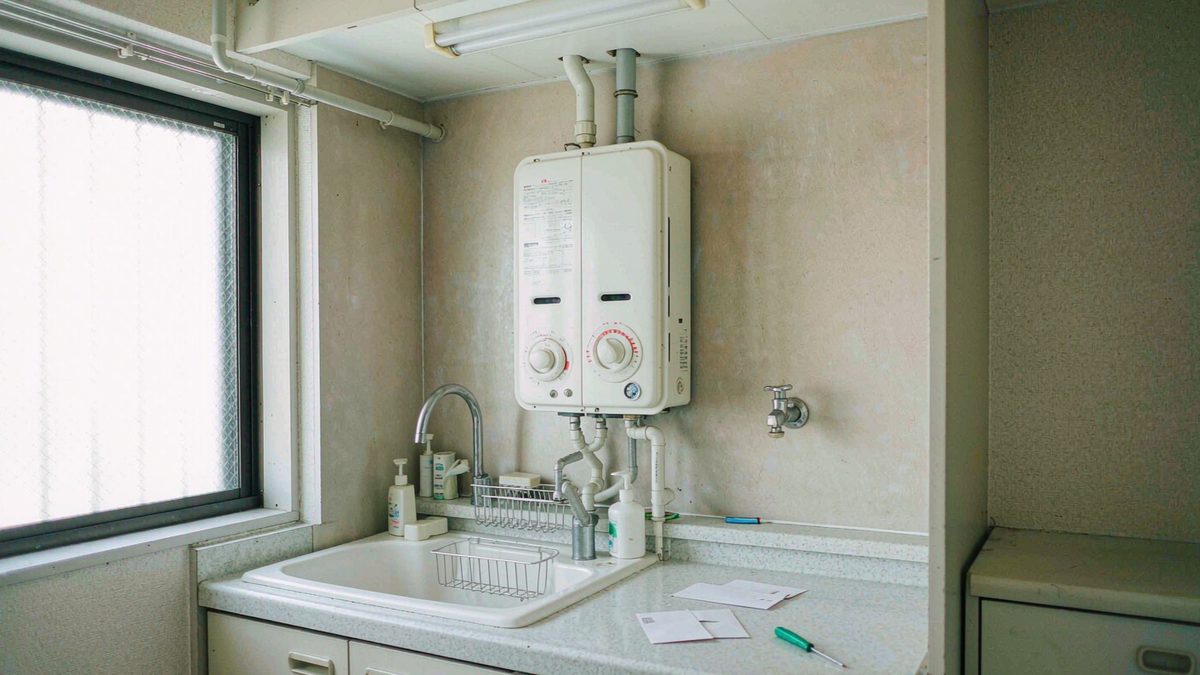
Setting Up Utilities
The slowest part of moving: which of the four to book first, why gas needs an appointment, and how not to overpay when you leave
Read the guide →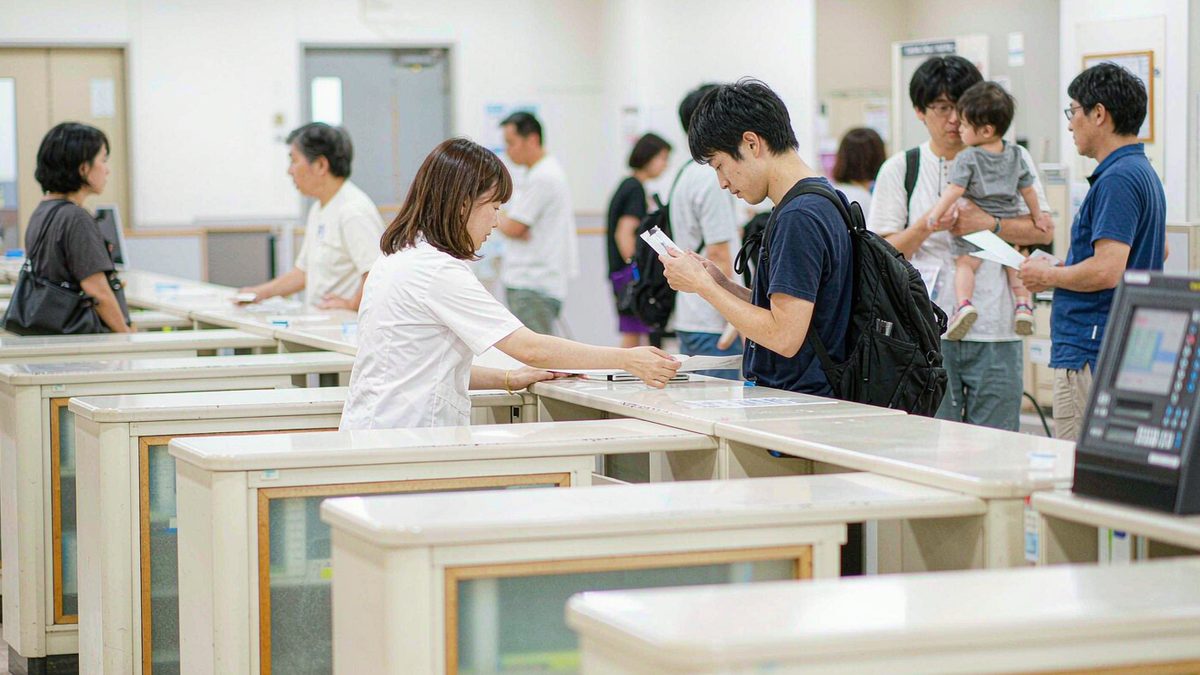
Ward Office Guide
Moving in and out, insurance, pension, seal registration — everything you can get done in one visit
Read the guide →