🗂️ Topic: Daily Life (4 guides, in situation order)
After a Traffic Accident in Japan: What to Do, in Order
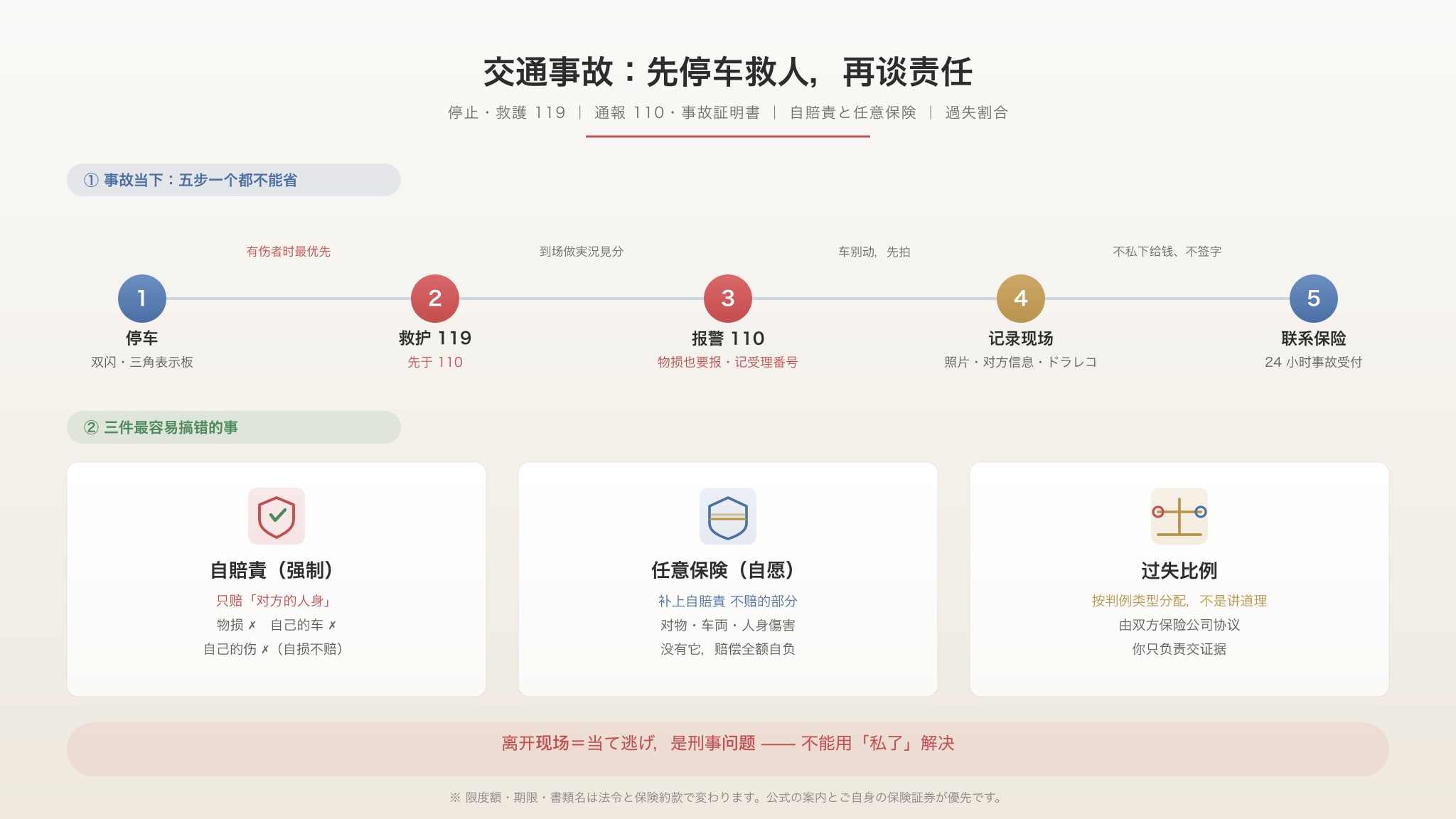
What a crash costs you in Japan is usually decided in the first ten minutes: whether you drove on, whether you agreed to "settle it privately", whether you assumed the compulsory insurance would cover everything. This page walks through the five things to do at the scene, how the police report and the accident certificate actually work, what 自賠責 covers and what only 任意保険 does, and how the fault split gets negotiated. The parts that catch foreign drivers out are in the last section.
📅 Checked October 2026Stop → call 119 if anyone is hurt → call 110 → secure the scene → call your insurer. Then deal with the hospital, the accident certificate and the settlement. Leaving the scene (atetōge) is a criminal matter in Japan, not something a private payment can fix — and even a car-park scrape with no injuries has to be reported to the police. The other thing to get straight: 自賠責 covers injury to the other party and nothing else. Damage to their car, your own car and your own injuries are outside it; that is what 任意保険 is for. Amounts, caps and deadlines change with the law and with your policy, so treat the official announcement and your own policy as the only authority.
📋 At a glance: the 8 things that matter
| # | What to do | The action that counts | If you skip it |
|---|---|---|---|
| 1 | Stop, prevent a second crash | Hazards, warning triangle, get people off the carriageway | Driving on = failure to render aid |
| 2 | Injured? 119 first | "Accident, people injured", location, how many | Delayed treatment, worse liability |
| 3 | Police: 110 | Report property damage too; note the case number | No accident certificate — insurer may refuse |
| 4 | Record the scene | Photos, other driver's details, witnesses, dashcam | Your account vs theirs, with no evidence |
| 5 | Call your insurer | The 24-hour accident line on your policy | Negotiating alone costs you money |
| 6 | See a doctor | Same day or next day; get a medical certificate | Whiplash symptoms later are hard to link |
| 7 | Get the accident certificate | Automobile Safety Driving Centre | Claim stalls without it |
| 8 | Settlement and fault split | Let the insurers negotiate; you supply evidence | Signing yourself is hard to undo |
* Exact procedure and form names vary slightly between prefectural police forces and insurers. Follow the officer at the scene and the wording of your own policy.
🚗 From stopping to settling: the full 8 steps
-
Stop first, and stop the second crash from happening
However minor the knock, stopping is the first legal duty. Driving on is not "we'll sort it out later" — it is a failure of the duty to assist and to report, and contacting the other driver afterwards does not undo it.
- Hazard lights on; side lights at night or in poor visibility
- Put out a warning triangle behind the car (on expressways the law requires a stop indicator; on ordinary roads it is still strongly advised)
- Get everyone behind the barrier or off the shoulder — never stand between the cars or wave traffic past from behind your boot
- Check for injuries before you look at the bumper
-
If anyone is hurt, call 119 before 110
Four pieces of information get the ambulance moving: "jiko desu" (there's been an accident), the location, how many are injured, and whether they are conscious. If you cannot give an address, name the intersection, the block, the nearest convenience store — the operator will work backwards from landmarks.
- Do not move an injured person unless there is fire or a risk of being hit again. If you must move them, note where and how they were lying
- Bleeding: press firmly with a clean cloth and keep pressing; don't lift it to check
- Confusion, neck pain, numbness in the limbs — treat it as serious and wait for the paramedics
-
Call 110 — yes, even for property damage only
"Nobody was hurt, so we don't need the police" is the most expensive misunderstanding on this page. The duty to report under the Road Traffic Act is not limited to injury accidents; damage-only collisions must be reported too. That report is what produces the accident certificate, and the certificate is what your insurer needs.
Say it in this order: ① traffic accident ② location ③ how many vehicles and whether anyone is hurt ④ your name and phone number. Officers will conduct an on-scene inspection and may ask for:
- Your Japanese driving licence (or international permit plus passport)
- Residence card, vehicle registration (shakenshō), proof of compulsory insurance
- For a rental: the rental agreement and the company's contact number
Before you leave, write down the case number and the name of the police station handling it. You need both in step 7.
-
Freeze the scene: photos, their details, witnesses
Before anything is moved, shoot in three passes — wide, medium, close:
- Wide: one from each of the four directions, with both cars, the road, the signals and the signs in frame
- Medium: where the vehicles ended up relative to each other, skid marks, debris, the stop line
- Close: both number plates, the damage, road surface (wet or dry), weather, and the time (photograph your dashboard clock)
Take the other driver's details in full: plate, name, address, phone, insurer and policy number, and their licence (photograph it, and check the name matches). Get witness phone numbers — people are willing at the scene and gone the next day.
If you have a dashcam, lock or copy the file on the spot so the loop recording cannot overwrite it.
⚠️ Do not argue about who was at fault at the roadside, and do not say "it was my fault" to be polite. That sentence can end up in the other party's written statement.
-
Call your insurer on the spot and hand the negotiation over
Every policy has a 24-hour accident line (most insurers also take reports in their app). Give them: time and place, whether anyone was injured, whether police attended, the case number, and the other vehicle's details and insurer.
Then hold one line: all money talk goes through the insurer.
- Do not hand over cash, even if the other driver suggests a small amount to end it
- Do not sign anything — not a settlement, not a memo, not a confirmation. Signed documents are very hard to reopen
- If the other party demands payment or threatens to call the police, hand them your insurer's number instead
- If they are uninsured or drive off: report it anyway, then claim through the government's compulsory-insurance compensation scheme and your own uninsured-driver cover
-
See a doctor the same day or the next
"I feel fine right now" is not a reason to skip it. Whiplash from a rear-end impact typically starts hurting two or three days later — by which point linking it to the crash is much harder.
Say clearly "kōtsū jiko no kega desu" (this injury is from a traffic accident), and give the date and the police case number. The medical certificate is what turns a damage-only case into a personal-injury case; the police reclassify it on that basis, and the insurance treatment changes with it.
Keep every receipt, treatment statement and transport ticket during the treatment period — all of it goes into the damages claim.
-
Get the traffic accident certificate
Once the police have logged the case, you can apply to the Automobile Safety Driving Centre for a traffic accident certificate (for damage-only cases, a certificate confirming the report was filed). Counter, post and online all work; there is a fee, and it usually takes a few days after the accident.
This is the document your claim rests on. If a name, plate or date does not match, the insurer sends it back — which is why the case number from step 3 matters.
-
Settlement and the fault split: let the insurers do it
A jidan (settlement) is the formal agreement on how much is paid. It is not an apology and not a handshake — once signed it is binding. The two insurers negotiate it using case-law categories. Your job is the evidence file: medical certificate, treatment records, repair estimate, replacement-car and transport receipts, proof of lost earnings.
If you disagree with the outcome you can ask for renegotiation, go to the ADR centre for traffic accident disputes, or use the legal-expenses option on your policy. Do not negotiate alone — you are at a disadvantage on both the language and the case law.
🛡️ 自賠責 vs 任意保険: who pays for what
| 自賠責 (compulsory) | 任意保険 (voluntary) | |
|---|---|---|
| Whose injuries | The other party's only | Other party, your passengers, yourself |
| The other car / property | Not covered | Property damage liability |
| Your own injuries | Not covered (single-car accidents are outside it) | Personal injury / passenger cover |
| Your own car | Not covered | Own-damage cover |
| Limit | Statutory cap; you pay anything above it | Whatever your policy says |
| If you don't have it | Penalties (fines, suspension) and you pay damages yourself | Not mandatory — but the whole risk sits with you |
* The compulsory caps are set by law and change with amendments; voluntary cover differs by insurer and policy. Amounts and conditions: official announcements and your own policy.
⚠️ Four things never to do
① Leave the scene. Even "just to find a phone" or "to the convenience store". The atetōge finding does not look at your intentions — it looks at whether you stopped, helped and reported.
② Pay cash at the roadside. A payment with no accident record leaves you with nothing if the other side changes their story or their injury turns out worse.
③ Say "it was entirely my fault", or sign anything. The split is negotiated from case law; a sentence you said to be polite can be quoted in their statement.
④ Assume "no injuries, no police". Damage-only collisions must be reported, and without the certificate the insurer may simply refuse the claim.
⚖️ How the fault split is actually decided
The split (kashitsu wariai) is not a moral verdict — it is a percentage assigned by accident type from case law. Insurers start from a base category (rear-end, intersection pull-out, turning, pedestrian crossing, car-door opening), then apply modifiers:
- Raising your share: unlit at night, clear speeding, inattention, phone use
- Lowering your share: the other party is a child or elderly, they ran a signal, the road layout itself is defective
So the same "I was rear-ended" can land on different numbers. The only part you control is the evidence: dashcam, photos, medical certificate, witnesses. Figures vary by accident type — go by what your insurer sets out and by the case law, not by the "rear-end is always 100:0" line that circulates online.
✅ Closing checklist
- Police case number and the handling station's name written down
- Accident certificate applied for (report certificate if damage-only)
- Medical certificate in hand; do not stop treatment early — a gap in attendance gets used to cut the settlement
- Other driver's plate, name, insurer and policy number all recorded
- Dashcam file backed up before it is overwritten
- Your insurer's handler name and claim number noted
- Repair estimate, replacement car, transport and lost-earnings documents kept
- Any traffic fine notice paid by the deadline — unpaid fines surface in visa renewals and permanent-residence reviews
🚑 What happens to the medical bills
The injury is covered by insurance, but the monthly cap on what you pay, and claiming it back from tax, are a separate system
❓ Common questions
The other driver says we don't need the police. Can I just go?
No. The duty to report is statutory, not something the two of you can waive. And with no record you get no accident certificate — which is the basis of the claim — and no answer if they later claim you drove off. Twenty minutes at the roadside is cheaper than three months of argument.
My Japanese isn't good enough for a 110 call
It is. Open with "kōtsū jiko desu", then give the location and whether anyone is injured. If you can't manage the address, name the intersection, the block number, the nearest convenience store — or hand the phone to a passer-by, a shop assistant, a colleague. You can ask for an interpreter when officers arrive, or work through a translation app sentence by sentence. Do not skip the report because of the language — that is the most expensive saving available.
Does a bicycle hitting someone count as a traffic accident?
Yes. A bicycle is a vehicle under the Road Traffic Act, so the duties to assist and report apply, and a cyclist can be the paying party — damages for injury have no cap. Some municipalities have made cyclist insurance compulsory or a duty of effort; check your own. The official local rule is what counts.
What if the other driver is uninsured, or drives off?
In both cases, report it to the police first. Where the other party had no compulsory cover or fled, you can claim through the government's compulsory-insurance compensation scheme (administered under the transport ministry) and through the uninsured-driver cover on your own policy. Neither route opens without a police record.
Will an accident affect my visa or permanent residence?
It depends on the offence and how serious it is. Drunk driving, hit-and-run and driving without a licence are serious enough to affect renewal and PR review. An ordinary damage-only accident, or a fine paid on time, is not normally a direct obstacle — but unpaid fines and a pattern of repeat offences are looked at. The standards are set by the immigration agency, so check its official guidance; if in doubt, ask before your renewal, not after.
What changes if it's a rental car?
The sequence is the same: stop → help → 110 → record → insurer. What differs is that you must also call the rental company, and check how the collision damage waiver and the non-operation charge apply on that contract. Don't negotiate with the other driver yourself — rental cover is not the same as a private policy.
Official sources: MLIT — compulsory insurance portal ↗ |Automobile Safety Driving Centre (accident certificates) ↗ |General Insurance Association of Japan ↗
Next
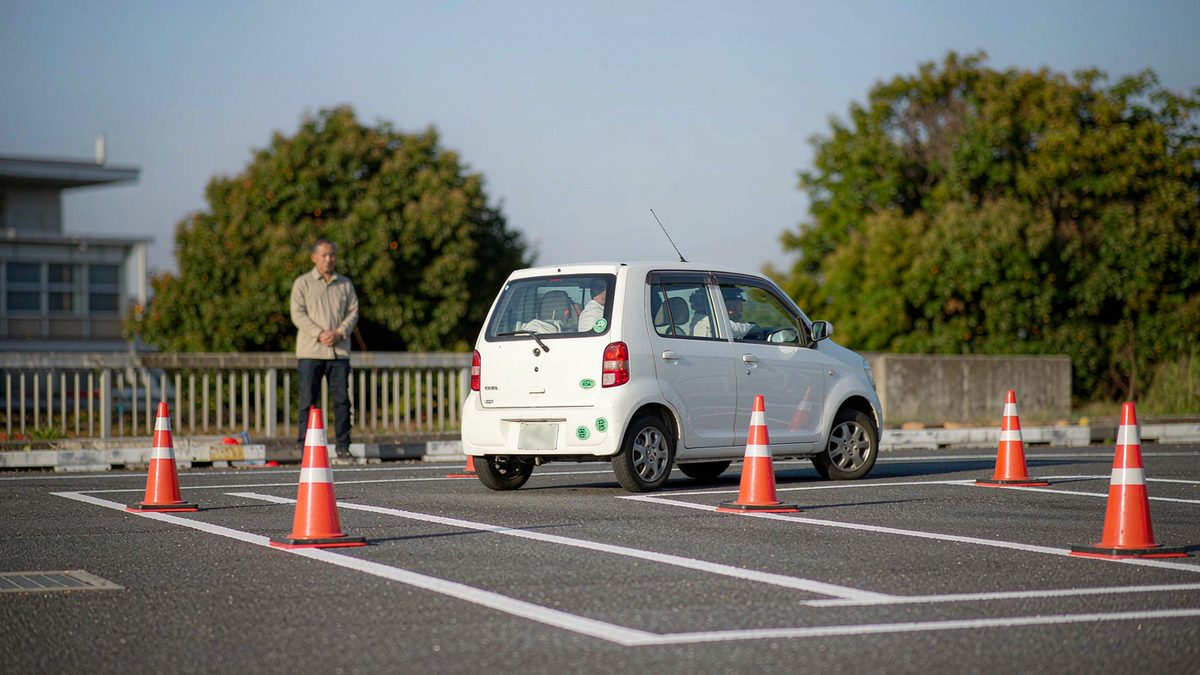
Converting a foreign licence
The prerequisite for driving here at all: document review, the knowledge and skills check, and the materials that get you sent home
Read the guide →
Getting medical costs back
The injury is the insurer's problem, but the monthly cap on your share and the tax deduction are a separate system
Read the guide →