🗂️ Topic: Money, Tax & Insurance (8 guides, in situation order)
Medical Costs in Japan: Refunds, the Ceiling Certificate and the Tax Deduction
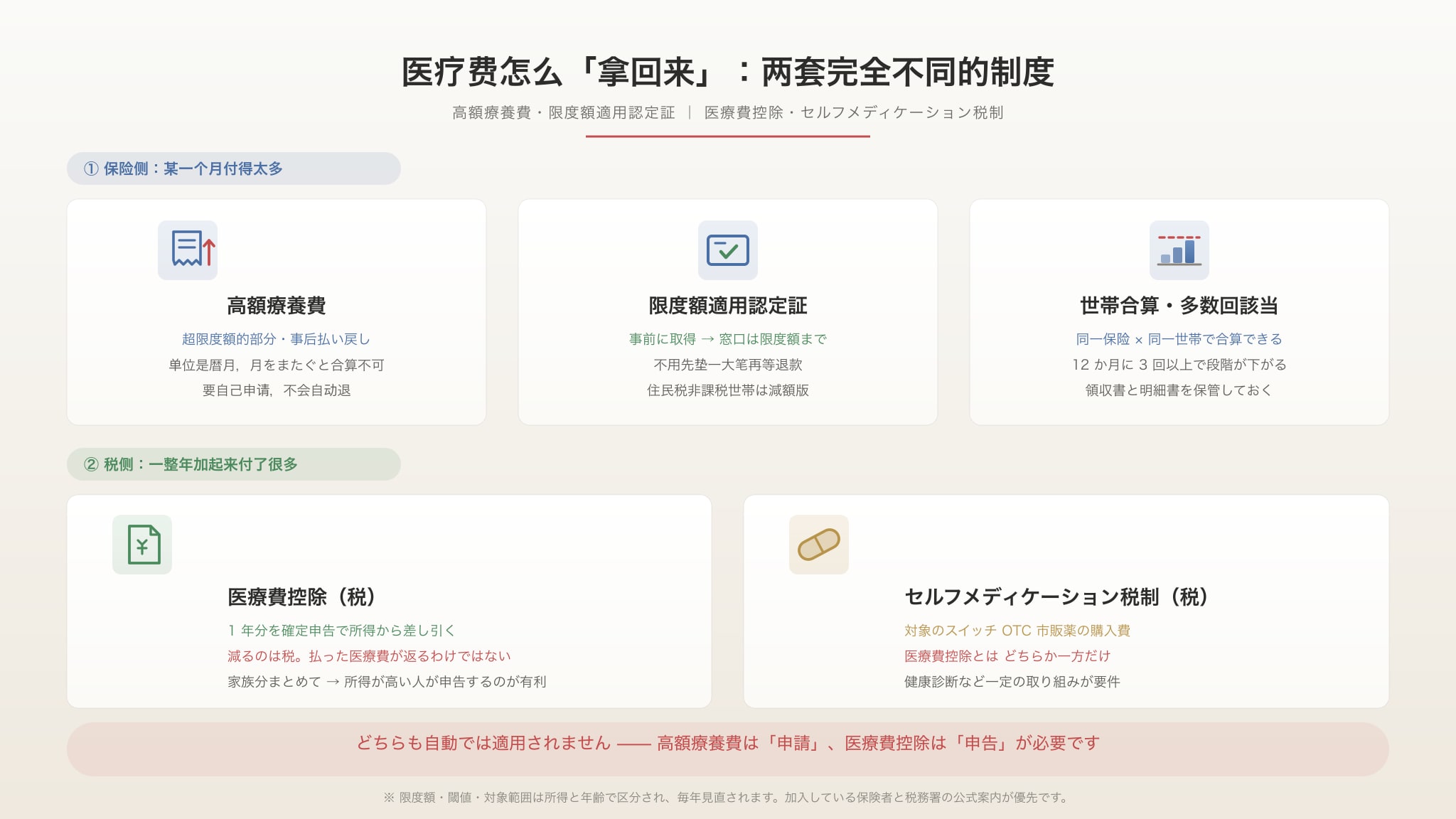
Getting money back for medical costs in Japan is not one system — it is two separate ones. The insurance side (高額療養費, plus the 限度額適用認定証 certificate) deals with one very expensive month. The tax side (医療費控除) deals with a whole year of spending. You can use both — they do not conflict. There is also a substitute route, セルフメディケーション税制, which covers designated over-the-counter medicine and is either/or with the tax deduction. This page is only about the money; for the actual process of seeing a doctor see seeing a doctor in Japan, and for filing generally see filing a tax return.
📅 Verified October 2026Work out which side pays and when. 高額療養費 is a refund from your insurer: if your covered share in a single calendar month exceeds your ceiling amount, the excess comes back to you. 限度額適用認定証 is the same scheme in advance — you apply to your insurer before treatment, show the certificate at the hospital counter, and pay only the ceiling instead of fronting the full bill and waiting weeks for a refund. 医療費控除 is an annual settlement on the tax side: if a calendar year of medical spending, minus reimbursements, passes a threshold, you deduct it from taxable income in your tax return — it reduces your tax, it does not refund your bills, and nothing happens unless you file. None of these apply automatically. Ceilings and thresholds are banded by income and by age and change with each year's tax rules — official guidance decides the numbers.
🧮 Run the numbers: what you pay, what you can claim back
This calculator covers the insurance side only (under 70). For the tax side — the 医療費控除 deduction — see the 🧾 医療費控除 section below; it is a separate scheme.
💴 Medical bill → what you actually pay
The monthly cap was raised for treatment from August 2026, and an annual cap was newly introduced. Pick the month you were actually treated.
Employees: check your 標準報酬月額. National Health Insurance: check 課税所得. When unsure, pick the lower bracket — the refund you see will be conservative.
⚠️ The most common mistake: this is NOT the 30% you paid at the counter. It is the full insured amount on the statement (10/10).
Common with ongoing treatment or repeated admissions. From the 4th time the cap drops a step further.
※ Insured items only — private-room surcharges, hospital meal charges and non-covered treatment stay out of pocket. A * marks the reduced 多数回該当 cap (from the 4th time).
⚠️ This is an estimate, not your insurer’s decision
- The co-payment rate is assumed at 30% (the norm under 70). Pre-school children pay 20%, and from age 70 the rate is 20% or 10% — a different rate changes both what you pay and what comes back.
- This tool covers under 70 only. From 70, outpatient and inpatient costs are judged separately (outpatient per person, outpatient + inpatient per household) and a different cap table applies.
- Costs are totalled per calendar month, per insurer. Changing insurer mid-month (for example leaving a job for National Health Insurance) splits the calculation between two insurers.
- Household aggregation (世帯合算) is not included: family members on the same insurance can add up their monthly co-payments above ¥21,000 each, which can drop the cap another step when several people need expensive care at once.
- The annual cap applies only from treatment in August 2026 onwards (a year runs August to July).
- Income brackets are scheduled to be subdivided from August 2027, and this table will need updating then. Always confirm the exact figures against the latest notice from MHLW and your own insurer.
📊 Monthly cap quick reference (under 70, treatment from Aug 2026)
| Income bracket | Monthly cap | From the 4th time | Annual cap |
|---|---|---|---|
| About ¥11.6M or more | ¥270,300 + (medical cost − ¥901,000) × 1% | ¥140,100 | ¥1,680,000 |
| About ¥7.7M – ¥11.6M | ¥179,100 + (medical cost − ¥597,000) × 1% | ¥93,000 | ¥1,110,000 |
| About ¥3.7M – ¥7.7M | ¥85,800 + (medical cost − ¥286,000) × 1% | ¥44,400 | ¥530,000 |
| About ¥3.7M or less | ¥61,500 (flat) | ¥44,400 | ¥530,000 |
| Resident-tax-exempt household | ¥36,900 (flat) | ¥24,600 | ¥290,000 |
※ Medical cost = the full insured amount (10/10). The monthly cap rises by the formula once the total passes the threshold.
📌 What changed in August 2026
- Monthly caps were raised across the board (e.g. the ¥3.7–7.7M bracket starts at ¥80,100 → ¥85,800).
- An annual cap was introduced: once your yearly total reaches it, further amounts are refundable.
- The reduced cap from the 4th time was not raised, so long-term patients bear relatively more.
- Further subdivision of income brackets is planned for August 2027 — this page will need updating again.
🧭 The four schemes at a glance: which side, what it covers, whether you must apply
| Scheme | Side | What it covers | Where to go | Apply yourself? |
|---|---|---|---|---|
| 高額療養費 | Insurance | The part of your covered share in one calendar month that exceeds your ceiling | Your insurer: National Health Insurance → your city office; employer insurance → the health insurance society or 協会けんぽ | Usually yes (some insurers pay automatically — see below) |
| 限度額適用認定証 | Insurance | The advance version — so the hospital counter charges only the ceiling | Same insurer as above | Yes, and you must get it before treatment |
| 医療費控除 | Tax | One year of medical spending, after reimbursements, above a threshold | The tax office (claimed in your tax return) | Yes — no claim, no refund |
| セルフメディケーション税制 | Tax | Designated over-the-counter medicine (switched OTC drugs) | Same tax office | Yes, and it is either/or with 医療費控除 |
* This is a routing table, not the full scheme. Ceilings, thresholds and eligibility are banded by income and by age, and they move with each year's tax changes — the numbers always come from your insurer and the tax office.
🏥 The high-cost benefit: how to claim it, and when to get the certificate first
This one is about a single expensive month, and the unit is the calendar month — 1 to 31 August, for example. Costs do not roll across months. If a hospital stay crosses a month end, the hospital bills it as two separate periods, which is exactly why people who "spent a fortune" sometimes get nothing back.
-
First check whether the month actually crossed your ceiling
The ceiling is not one number — it is banded by age (under 70 and 70-plus are different schemes) and then by income. So the first question is which band you are in, and the answer lives with your insurer. Official guidance decides.
Only your insurance-covered share counts. Things outside cover — a private-room supplement (差額ベッド代), optional add-on treatments — do not enter the calculation. Inpatient meal costs are handled separately under their own rules.
-
Household members on the same insurance can be added together
It is not only about one person's month: people on the same health insurance who live in the same household can combine their shares. A family all seeing doctors in the same month, each below the ceiling individually, may still qualify once added up.
National Health Insurance works at household level — applications and refunds go through the household head. Employer insurance depends on who is enrolled and who is a dependant. How combining works is set by your insurer.
-
If you know it will be expensive, get the 限度額適用認定証 beforehand
When you already know a large bill is coming — surgery, a hospital stay, long treatment — the correct order is: apply to your insurer for the ceiling-amount certificate first, then show it at the counter. The hospital then charges you only the ceiling, and you skip fronting a large sum and waiting a month or two for the refund.
Households exempt from residence tax use a reduced-standard-benefit version of the same certificate, which also lowers the inpatient meal charge. Certificates expire, so renew them for long treatment. Documents, validity and eligibility follow official guidance.
Also worth knowing: the My Number health insurance card can now apply the ceiling automatically once you have registered it, without a paper certificate — how this is operated follows official guidance. If you still rely on the older card, or your insurer's systems are not there yet, getting the certificate in advance is still the reliable path.
-
Already paid? Claim the refund afterwards — and watch the deadline
If you missed the certificate, or only found out afterwards that you qualified, you claim after the fact: apply to your insurer with receipts and the itemised treatment statements (exact documents follow official guidance). Some insurers pay automatically because they already have the figures — but that is not universal, so do not assume it and ask once.
Two traps: the deadline — there is a time limit and once it passes the money is genuinely gone (the limit follows official guidance); and supplementary benefits — some insurance societies pay their own extra benefit, and where that exists it is normally paid first, with only the remainder going through the high-cost scheme. The same cost is never paid twice.
-
Long treatment: watch for the "multiple claims" rule
If you have met the high-cost threshold three or more times within the last 12 months, from the fourth time the ceiling drops to a lower band. For long treatment, or several procedures in one year, that difference is large.
It accumulates per household per insurer rather than by application, but how it is determined and applied follows official guidance. If you are in a long treatment cycle, keep every receipt and statement — do not discover at the end that you qualified months ago.
🧾 医療費控除: a year of spending, deducted from income
This is tax, not insurance. It covers a whole calendar year (1 January to 31 December) of medical spending, and you claim it in your tax return.
| Item | What matters |
|---|---|
| How it is calculated | (Medical costs paid in the year − reimbursements such as insurance payouts) − a threshold. The threshold is the lower of a fixed amount and a percentage of your income, and there is a cap. Exact figures follow official guidance. |
| Who can claim | Someone with income in that year. A person with no income cannot claim in their own name. |
| Claiming for family | Costs of family members who share a household and a budget can be combined and claimed by one person. Because this is an income deduction — it cuts income, and the tax you save depends on your rate — having the highest earner in the household claim everything usually returns the most. Who actually saw the doctor is irrelevant. |
| Typical eligible costs | Doctor and dentist treatment, medicine used for treatment, therapeutic appliances, public transport to and from appointments (taxis when genuinely unavoidable), the inpatient meal charge you paid, orthodontics for medical reasons (not cosmetic), rehabilitation, nappies used under a doctor's instruction, and childbirth (after subtracting the birth grant and similar payments). |
| Typical ineligible costs | Health checks and full medicals as a rule, vaccinations, cosmetic surgery and whitening, private-room supplements, petrol and parking for driving yourself to appointments, purely "staying healthy" spending, and any part someone else actually paid. |
| What you submit | In principle a schedule of medical expenses listing providers and amounts. You do not attach receipts — but you keep them for five years and produce them if asked. The general filing process is in filing a tax return. |
| Can you claim late? | Yes. Refund claims can be made going back a number of years (the window follows official guidance). If you skipped it in past years, it is often still recoverable. |
⚠️ The most common misunderstanding: 医療費控除 does not refund your bills
It is an income deduction, not a tax credit. The logic, with illustrative figures only (real thresholds and rates follow official guidance): it removes part of your income from tax, so what you save is the tax on that income. The amount returned is therefore far smaller than what you paid, and the higher your income, the more a given bill returns. Set your expectations here, or you will file and wonder why the refund is so small.
💊 セルフメディケーション税制: pick this or the deduction, not both
This is a special version of the medical expense deduction for designated over-the-counter medicines: the annual spend above a threshold is deductible, up to a cap. The important part is that you cannot use both — you must choose between this and 医療費控除, so pick whichever returns more in your case.
- There is a precondition. You normally need to have done something such as a health check, a vaccination or a specific screening in the year. Buying medicine alone generally does not qualify.
- It only covers shop-bought medicine, not consultations. Prescriptions from a hospital or pharmacy go through insurance and the ordinary deduction instead.
- Both the scheme's expiry and the list of qualifying products are revised — official guidance decides. Check that it still applies for the year before you rely on it.
❌ Six places people lose money
- Adding up costs across months. The high-cost benefit works by calendar month. Admitted 30 July and discharged 10 August means two separate periods — each below the ceiling, so nothing comes back.
- Assuming it is automatic. The high-cost benefit usually needs an application (automatic payment exists with some insurers, but it depends on them), and the tax deduction never happens unless you file. Both fail silently.
- Counting costs that are outside cover. Private-room supplements and optional add-ons are not insurance-covered and do not enter the high-cost calculation — and generally are not deductible either, though that is judged case by case.
- Going into hospital without the ceiling certificate. You end up fronting the full amount and waiting over a month for the refund. Applying in advance is free and removes that cash-flow hit entirely.
- Forgetting to subtract payouts. High-cost refunds, private medical insurance payouts, the childbirth grant — these already covered part of the cost, so they come off before you calculate the deduction. Skipping this makes the return wrong.
- Claiming through the wrong person. Combining family costs is allowed, but claiming through the lowest earner simply returns less. The rule of thumb: the highest earner claims everything.
❓ Common questions
I am on National Health Insurance — where do I claim the high-cost benefit?
At your city or ward office, which is your insurer. Forms are usually available at the counter or online, and receipts are attached (details follow official guidance). National Health Insurance is handled per household, so applications and refunds normally go through the household head. If you are on employer insurance instead, the destination is that insurance society, not the city office — ask HR which insurer you are with and save yourself a trip.
Do I need both the ceiling certificate and the high-cost claim?
Not both — they are two routes to the same entitlement. Use the certificate when you can predict the cost, so the counter charges only the ceiling and you skip the outlay. Use the after-the-fact claim when you could not get the certificate in time, or only realised later. The same cost is not paid twice: whatever was already charged at the ceiling is settled and will not be refunded again. Money already paid out is recovered through the later claim.
Can I include my child's or my spouse's treatment?
Yes, where the combining rules apply to you and you share a household. On the insurance side the test is same insurer + same household, combined within a month. On the tax side the test is sharing a household and a budget, combined across the year and claimed by the highest earner. The two thresholds are different — do not mix them up. Determinations follow official guidance and your insurer's own rules.
Do fillings, braces and dental work count?
It depends. Treatment dentistry — fillings, extractions, gum treatment — is insurance-covered and deductible. Orthodontics counts where it is for medical reasons, such as chewing function; purely cosmetic work does not. Whitening is generally treated as cosmetic. These judgements depend on the actual treatment, so if in doubt ask the clinic for a document stating the medical purpose.
What about the prescription I collect from the pharmacy?
Prescription medicine paid at the hospital and the pharmacy is insurance-covered, so your share counts towards the same calendar month for the high-cost calculation — hospital and pharmacy charges are normally attributed to the same month. At year end it is also deductible. Put both the clinic and the pharmacy name on your schedule of expenses, so do not throw away either receipt.
Can I claim for treatment abroad, or after leaving Japan?
Two separate answers. The high-cost benefit is built around treatment covered by Japanese insurance, so treatment abroad generally falls outside it, with limited exceptions that follow official guidance. The tax deduction is broader: overseas medical costs can qualify subject to conditions, and you will need translations and similar supporting documents. Before you leave Japan, settle any unclaimed high-cost refunds and any refund claims still inside the window — doing it remotely afterwards is far harder. For the wider exit picture see NHI, pension and lump-sum withdrawal.
Official references: MHLW — high-cost medical expense benefit ↗ |NTA — medical expense deduction ↗ |NTA — self-medication tax scheme ↗
Next steps

Seeing a doctor in Japan
Before the money side, get the process right: finding a clinic that takes foreign patients, referral letters, the questionnaire, night-time care
Read the guide →
Filing a tax return
The medical deduction is one line in a bigger return. When filing is required, what to prepare, and what changed for 2026
Read the guide →
NHI, pension and lump-sum withdrawal
If your employer does not enrol you, health insurance and pension are yours to handle — and part of the pension can be claimed back when you leave
Read the guide →