🗂️ Topic: Money, Tax & Insurance (8 guides, in situation order)
Having a Baby in Japan: The Paperwork Chain From Pregnancy to Nursery
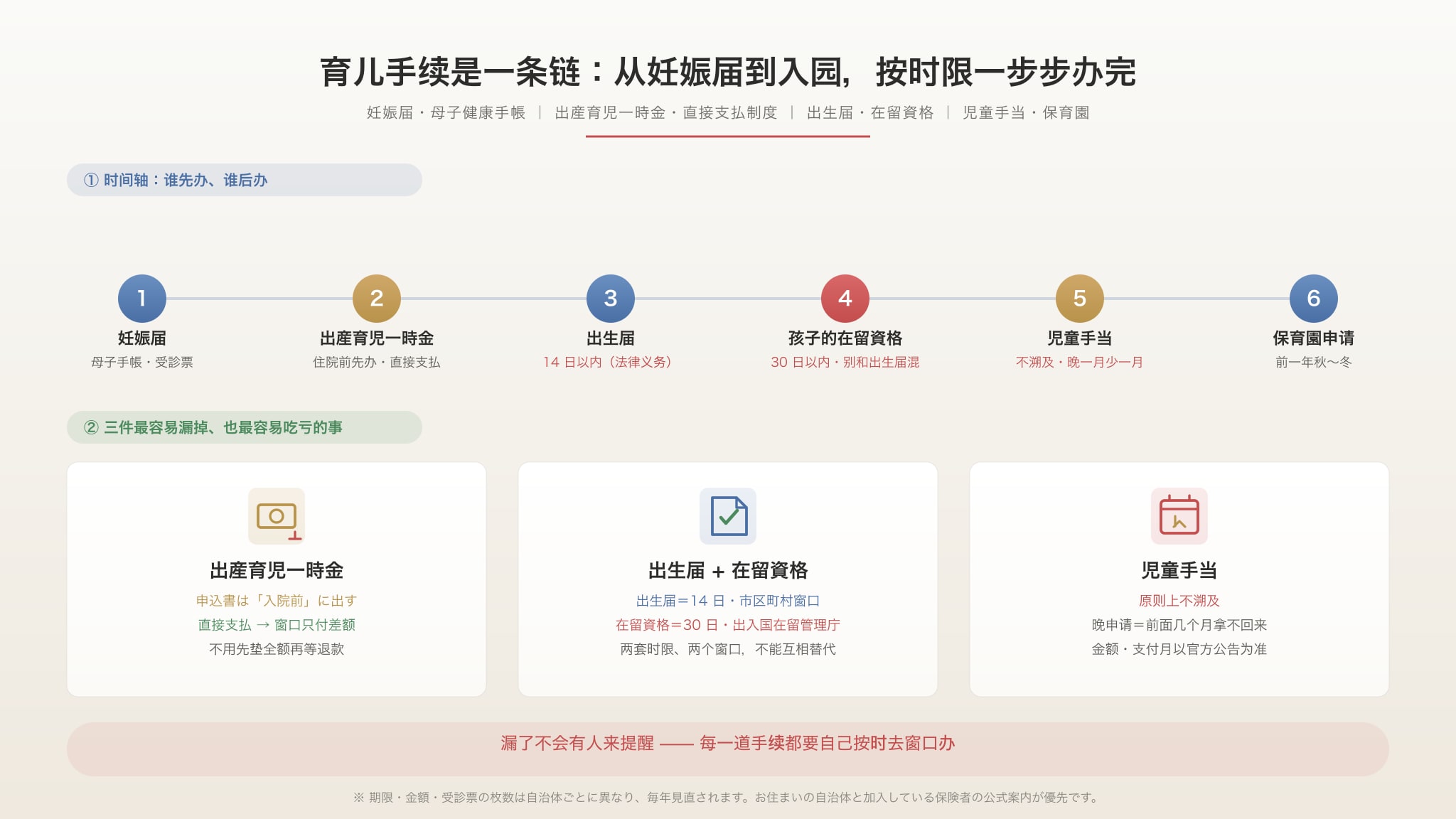
Having a baby in Japan is not a pile of forms — it is a chain with an order to it: pregnancy notification → mother-and-child handbook → the childbirth lump sum → birth registration → child allowance → nursery application. Each link has its own deadline and its own counter, and nobody will chase you if you miss one. Benefits are not automatic, and the city office will not call. This page walks the chain in the order it actually happens.
📅 Verified October 2026Start at your city or ward office with a 妊娠届 (pregnancy notification). You come away with the 母子健康手帳 and a booklet of antenatal checkup vouchers — with those, most of your pregnancy checkups cost nothing. For the delivery itself, use the 直接支払制度 through your health insurance: the insurer pays the hospital directly and you only settle the difference at discharge, instead of fronting the whole bill. After the birth, file the 出生届 within 14 days — and at the same counter, do the child allowance, health insurance and child medical subsidy in one trip. Two things catch people out: the child allowance is not paid retroactively, and a child who is not Japanese also needs their own residence-status application. Amounts, voucher counts and deadlines change every year and differ by municipality — always treat the official notice as the source of truth.
📋 At a glance: the eight steps in this chain
| When | What | Where | Cost of missing it |
|---|---|---|---|
| Early pregnancy | 妊娠届 → handbook + checkup vouchers | City/ward office health desk | You pay full price for every checkup |
| During pregnancy | Checkups with vouchers / 出産育児一時金 paperwork | Clinic + your insurer | You front the entire delivery cost |
| Within 14 days of birth | 出生届 (birth registration) | City/ward office | A fine — this one is a legal duty |
| Within 30 days of birth | Residence status for the child (non-Japanese only) | Immigration Services Agency | The child is overstaying |
| As soon as possible | 児童手当 (child allowance) | City/ward office | Not retroactive — you lose months |
| As soon as possible | Health insurance + child medical subsidy | Employer or city office | You pay full price at the doctor |
| From 2 months old | Routine vaccinations | Designated clinics | You have to catch up before nursery/school |
| Autumn–winter of the year before entry | Nursery (保育園) application | City/ward office | Another year on the waiting list |
* Deadlines and counters vary a lot between municipalities. This table is the common pattern — your own city's notice is what counts.
🍼 Pregnancy to nursery: the eight steps
-
Early pregnancy: file the pregnancy notification
Once the pregnancy is confirmed, go to the health desk of the city or ward you live in and file a 妊娠届. You leave with three things:
- The 母子健康手帳 (mother-and-child handbook) — it records the whole pregnancy, the birth and every vaccination. You will need it for nursery and school applications, and it is meant to last a lifetime. Do not lose it.
- A booklet of 妊婦健診受診票 (antenatal checkup vouchers) — these cover most or all of the standard checkups
- Various other coupons and referral slips (ultrasound, dental check, health-visitor appointment) — what you get differs by city
The usual timing is around weeks 8–12, but it varies; going early does no harm, and the vouchers normally carry an expiry date. Bring anything confirming the pregnancy (a certificate from the clinic), your residence card, My Number, health insurance card and your personal seal (印鑑). If your Japanese is not there yet, the international desk at the city office can tell you exactly what to bring.
-
During pregnancy: use the vouchers, and sort out the delivery payment
Hand over a voucher at each checkup and the covered part is free on the spot. Note that the number of vouchers is limited — anything beyond them you pay for. The allocation is based on how far along you are and differs by municipality.
The delivery itself is covered by the 出産育児一時金 (childbirth lump sum), paid out of whichever health insurance you are in — company insurance or National Health Insurance both qualify. There are two ways to receive it, and you want the first one:
- ① 直接支払制度 — direct payment (recommended). You submit the direct-payment form to the hospital in advance; the insurer pays the hospital and you only pay the difference when you are discharged. No large sum up front.
- ② Claim afterwards. You pay the hospital in full yourself and claim the money back from the insurer later. You need the cash, you wait weeks, and there is a real gap in your finances at the worst possible time.
If you go with direct payment, the form has to reach the hospital before you are admitted — not on the day you go into labour. The amount and any add-ons (such as the obstetric compensation scheme) are set by official notice, so check the current figure rather than a blog post.
-
Within 14 days: birth registration (出生届)
This one is a legal obligation with a 14-day deadline from the date of birth, and there is a penalty for missing it. This is not a "should do soon" item. The hospital gives you the 出生届 form and the 出生証明書 (the certificate the doctor completes and stamps).
File it at the city or ward office covering the parents' address. Bring:
- The hospital's 出生届 + 出生証明書
- The 母子健康手帳
- Your personal seal (the form has a field for the reporter's seal)
- My Number and residence card, if you are not Japanese
The same deadline applies if the baby was born abroad, but the registration is still filed with a Japanese municipality — families planning an overseas birth should confirm the mechanics with the office in advance.
-
Within 30 days: the child's residence status (non-Japanese only)
This is the step readers of this site most often miss: a baby born in Japan does not get a residence status automatically. The parents must apply to the Immigration Services Agency for 在留資格取得許可 within 30 days of the birth. Past that, the child is overstaying — which puts the child's status at risk and can come back on the parents too.
After that comes the child's 在留カード and the address registration. In most cases the child takes a status tied to the parents' (家族滞在 being the common one), but the details are a matter for the Immigration Services Agency's published rules.
Remember this is a different counter and a different clock from the birth registration. Filing the 出生届 at the city office does not do this for you.
-
As soon as possible: the child allowance (児童手当)
The child allowance is not paid retroactively. The usual rule: apply within 15 days of the day after the birth and payments start from the month of birth. File later and payments start from the month you applied. Wait a month and you simply lose a month, permanently.
Apply at your city or ward office. Bring:
- The application form (認定請求書), provided at the counter
- Health insurance card / pension number, to establish the parents' eligibility
- A bank account in the applicant's own name — this is the normal requirement
- My Number and residence card
Payments are made roughly three times a year (commonly June, October and February, each covering the preceding months) — the exact dates differ by municipality. The scheme has been expanded in recent years (ages covered, higher rates for third and later children, income limits), so take the amount and conditions from the current official notice; a lot of the numbers still circulating online are out of date.
-
As soon as possible: get the child onto health insurance and the medical subsidy
Which route you take depends on what insurance the parents are in:
- Company health insurance — submit a 被扶養者(異動)届 through your employer so the child joins as a dependent. The date the dependency is recognised affects what you can claim, so do not sit on it.
- National Health Insurance — file the enrolment form at the city or ward office; the insurance card follows by post.
Separately, apply for the municipality's child medical expense subsidy (乳幼児医療費助成 / 子ども医療費助成). Registering gets you a certificate or coupon booklet that reduces or reimburses the patient's share of consultations and hospital stays. The ages covered and any income conditions are set locally — read your city's notice.
One more, easy to forget: if you are a Category 1 insured person under the National Pension, there is a pre- and post-birth pension contribution exemption you have to apply for. Students and self-employed readers in particular should not skip it.
-
From two months old: routine vaccinations
Your municipality sends pre-examination slips / vaccination tickets, and routine jabs at designated clinics are free at the point of care. The usual starting point is two months old, but there are several vaccines and the intervals matter — the health desk hands you the schedule along with the handbook.
- Bring the handbook and the ticket; every vaccination is recorded in the handbook
- Tickets have expiry dates — exchange them at the counter if they lapse
- Nursery and school entry require a vaccination record; gaps have to be caught up
Schedules differ slightly by municipality, so follow the tickets and the schedule you were given. If the child has a fever or is under treatment, ask the doctor first.
-
Autumn–winter of the year before entry: nursery application
This is the step with the earliest deadline and the most people caught out. Applications for April entry are normally accepted in the autumn or winter of the previous year, and each municipality has its own window and method (post, online, counter). Miss the round and you are waiting for the next one, or for a second-round vacancy.
The core of it is the 利用調整指数 — a points system. Parents' employment situation, single-parent status and household composition all score points, and families are ranked by total to decide who gets a place and where. Typically you will need:
- A 就労証明書 (employment certificate) completed by your employer on the municipality's own form — this is the step that most often delays an application
- The application form itself, listing your preferences in order; how many you may list depends on the area
- Residence card, My Number, and the handbook
Also look at 認定こども園, 地域型保育 and unlicensed facilities (認可外) — they have their own application routes and fee structures, and some do not go through the city's central allocation at all. Do not assume the licensed nursery is the only door.
⚠️ The two places people lose money
① The child allowance does not back-pay. A lot of people assume it will be settled later; it is not — payments start from the month of application, and the earlier months are simply gone. ② The 14-day birth registration and the 30-day residence-status application are two separate clocks at two separate counters. Filing the birth registration at the city office does not handle immigration for you. Nobody reminds you about either.
✅ Wrap-up checklist
- Keep the 母子健康手帳 safe — checkups, vaccinations, nursery and school all ask for it
- Confirm the direct-payment form for the delivery reached the hospital before admission
- Keep every receipt and itemised statement — you will want them for the medical expense deduction later (see the related page below)
- After the birth registration, check that the child allowance, health insurance and child medical subsidy were all done at the same counter
- The child's residence status application and residence card, if you are not Japanese
- Your monthly budget has changed — check whether residence tax and National Health Insurance premiums move with it
- Put the nursery application window in your calendar: autumn to winter of the previous year, not spring
💴 What does your take-home look like with a child?
Adding a dependent changes health insurance, residence tax and income tax. Run the numbers before you plan a budget
❓ Common questions
What about the child's medical costs? A hospital stay is expensive
Start with the child medical expense subsidy — once registered, the patient's share of consultations and stays is reduced or reimbursed under your municipality's rules. For a large bill, the insurance side also has the high-cost medical benefit and the 限度額適用認定証, which caps what you pay at the counter; applying for that certificate before admission means you only ever pay the ceiling amount. Both are explained in Getting medical costs back.
If we go back home for the birth, do we still get the lump sum?
Yes — an overseas delivery is still eligible. You cannot use the direct-payment route, so you pay and claim from the insurer afterwards. You will need the local hospital's birth documentation (sometimes translated), and the claim has a time limit. The exact document list and deadline are set by your insurer, so ask them before you travel, not after.
Both parents are foreign — what status does the child get?
Normally a status tied to the parents' — for example where the parents hold a work status, or permanent residence, the child's position differs. The application deadline is 30 days from the birth, and past that the child is overstaying. Get to the Immigration Services Agency inside those 30 days, and register the child's address once the residence card is issued. Which status fits and how long it runs are set out by the Immigration Services Agency; if you are unsure, ask them rather than waiting.
I will have no income before and after the birth — what happens to pension and insurance?
Category 1 National Pension members can apply for the pre- and post-birth contribution exemption. If you are employed, two other systems come into play — 出産手当金 (from health insurance) and 育児休業給付金 (from employment insurance). They are separate systems with separate applications; this page does not cover them. Your HR department or Hello Work is the fastest route, and the conditions and amounts follow the official notices.
The baby is born abroad — what do we do when we come back to Japan?
Roughly this order: ① register the birth locally; ② file a birth registration with the Japanese embassy or consulate, which is also subject to a deadline; ③ after arriving in Japan, apply for 在留資格取得許可 and the residence card; ④ register the address, then apply for the child allowance, health insurance and medical subsidy. Several of these clocks only start once you are in Japan, so do not leave it until you land — confirm the document list with the destination office and the embassy before you travel.
Official sources: Children and Families Agency ↗ |Immigration Services Agency ↗
Next steps
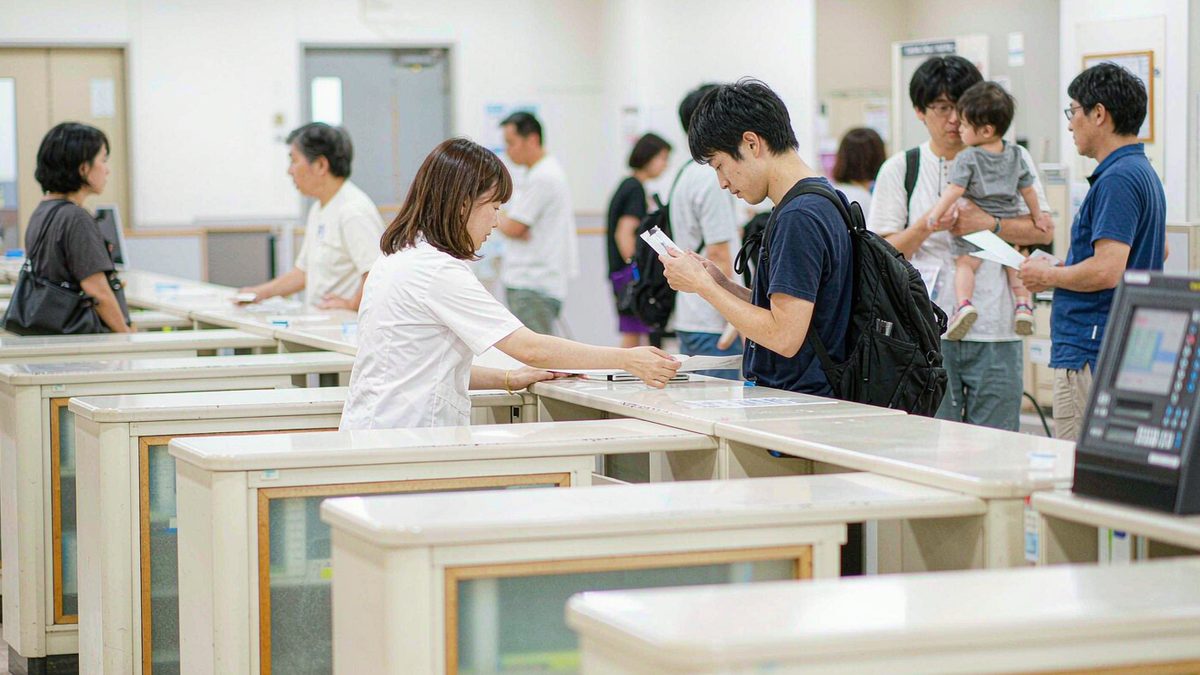
City office counter guide
The pregnancy notification, birth registration, child allowance and insurance all happen at the same city office. This guide covers which counter does what, in one trip
Read the guide →
National Health Insurance and pension
If your employer does not enrol you, the child's insurance and the pre- and post-birth pension exemption both sit inside this system
Read the guide →