Seeing a Doctor in Japan: From Choosing a Clinic to Getting Medicine
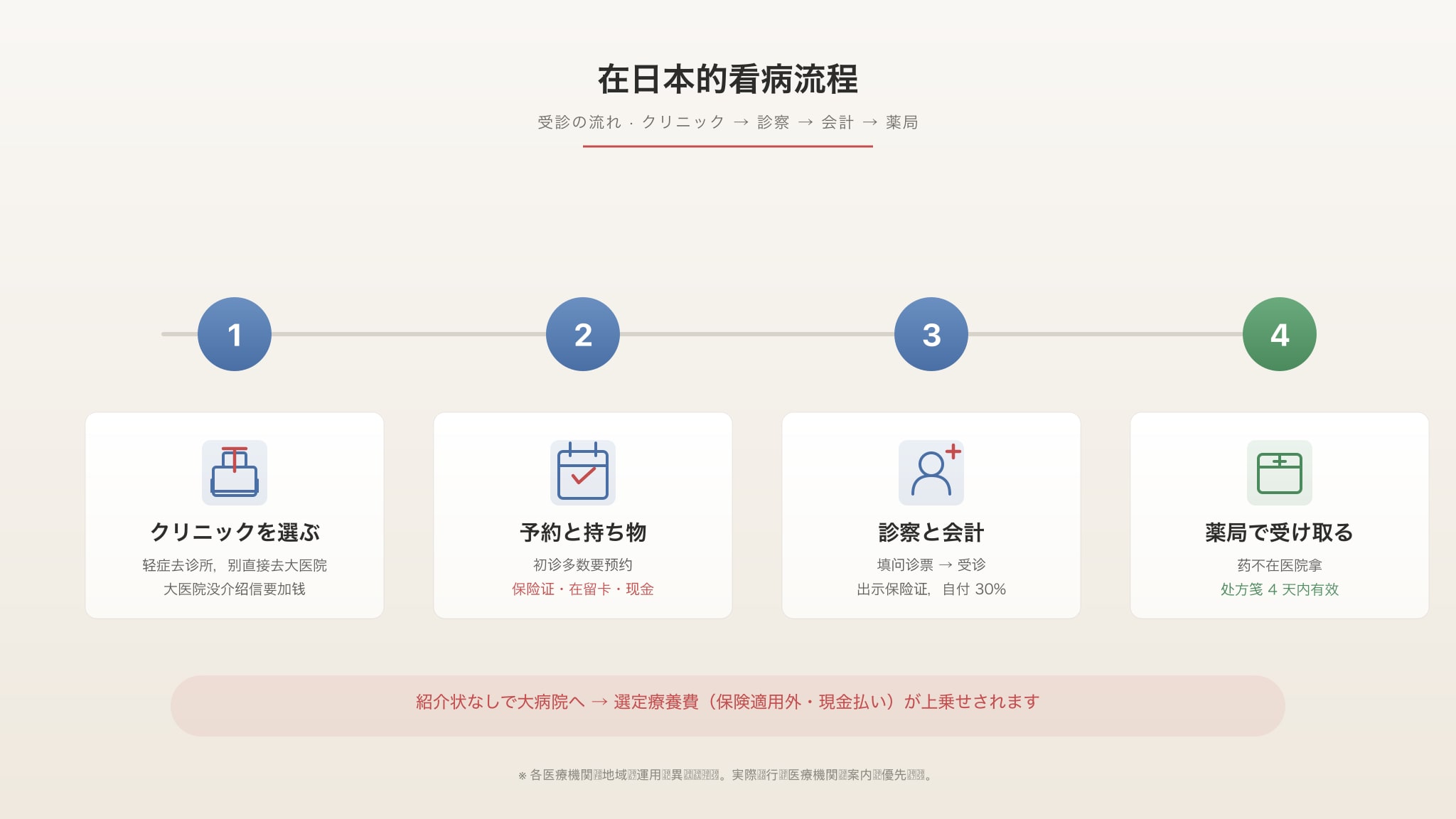
Seeing a doctor in Japan works differently from most countries: clinics and hospitals are strictly divided, walking into a big hospital without a referral costs you extra, and many clinics close over lunch. This guide walks the whole chain, from deciding to go to picking up your medicine.
📅 Page verified: September 2026For anything minor, go to a neighbourhood clinic (クリニック), not a big hospital — turning up at a hospital without a referral letter (紹介状) adds several thousand yen to your bill. Bring your insurance card and Residence Card; you pay 30% of the cost. After the consultation the doctor hands you a prescription (処方箋) — hospitals don't dispense medicine. You take it to a separate pharmacy and pay there.
📋 At a glance: where to go for what
| Type | Size | Good for | Watch out |
|---|---|---|---|
| Clinic (クリニック / 診療所) | Small, 1–few doctors | Colds, fever, stomach, skin, common internal medicine | Often single-specialty — pick the right one |
| General / university hospital | Large, multi-department, inpatient | Imaging, surgery, complex conditions | No referral letter = extra fee |
| Emergency room (救急外来) | Large hospitals only | Trauma, sudden severe pain, loss of consciousness | Non-emergencies get turned away — plus a surcharge |
| Pharmacy (薬局) | Separate shop | Filling your prescription | Billed separately from the hospital |
* Rules vary a lot between hospitals and regions. What your specific hospital says is what counts.
🩺 From deciding to go, to holding your medicine: 7 steps
-
Decide: clinic or hospital?
This step decides how much you pay. Japan runs a split system: clinics handle everyday illness, hospitals handle serious and complex cases. If you go straight to a hospital and they judge you should have seen a clinic first, they charge a referral-free surcharge (選定療養費) — roughly ¥5,000–¥7,700 depending on the hospital. Insurance does not cover it, and it must be paid in cash.
The test is simple: you can walk in and explain what hurts → clinic. High fever lasting days, severe pain, injury, confusion → hospital or emergency.
-
Find a clinic that accepts foreign patients
Not every clinic takes foreign patients. Three signals to look for:
- Signage or website saying 「外国人の診療可」 (accepts foreign patients)
- JMIP certification (a national accreditation for treating international patients) — common at larger hospitals
- Website listing language support (English, Chinese, Korean, etc.)
The Ministry of Health, Labour and Welfare and each prefecture publish directories of medical institutions that accept foreign patients. Searching 「外国人 医療機関 検索」 plus your area usually finds them. If you come up empty, ask the international desk at your ward office or your local international association — they keep local lists.
-
Book an appointment
Most Japanese clinics run by appointment, particularly for first visits. Walking in unannounced can mean being turned away or waiting hours.
On the phone, cover three things: 「初診です」 (this is my first visit), your main symptom, and your preferred time. If your Japanese is shaky, write it down and read it out, or use a translation app's voice mode. Some clinics accept online booking.
-
Pack the right things before you leave
- Insurance card (National Health Insurance or employer insurance) — without it you pay full price
- Residence Card — some clinics ask at registration
- Cash — plenty of clinics don't take cards. This is the single most common thing people get caught by
- A note of your current medications and allergies — you'll need it for the intake form
- Referral letter (if you have one, for a hospital visit)
-
Register and fill in the intake form (問診票)
Hand your insurance card to the 受付 (reception), then fill in the 問診票 — a form about your current symptoms and medical history. Typical fields:
- Chief complaint (what's wrong, since when)
- Past medical history (hypertension, diabetes, etc.)
- Medications you currently take
- Allergies — especially drug allergies
- Smoking / drinking; for women, whether pregnancy is possible
If your Japanese isn't up to it, ask them to speak slowly or write kanji for you — Chinese speakers can often follow written medical terms. You can also pre-translate your symptoms in an app and show reception.
-
Consultation → pay at the 会計 window
See the doctor, explain your symptoms. Afterwards, wait until your number is called for the 会計 (payment window).
With your insurance card, you pay 30% of the medical cost (different rates apply to preschool children and ages 70–74). The first bill item is the 初診料 — the first-visit fee, higher than a return visit — followed by tests and treatment.
If the bill is large, ask the hospital 「限度額適用認定証は使えますか」 (can you accept the ceiling-amount certificate?). With that certificate you pay only the monthly ceiling on the spot instead of fronting the full amount and claiming a refund later.
-
Take the prescription to a pharmacy (a separate bill)
Japanese hospitals don't sell medicine. The doctor gives you a 処方箋 (prescription) that you take to a 薬局 (pharmacy) — often next door but effectively a separate business. Medicine is billed separately, insurance card again, 30% again.
Prescriptions have an expiry (usually 4 days including the issue date). Miss it and you have to see the doctor again. The pharmacy will start you a お薬手帳 (medicine notebook) — carry it to every appointment so any doctor can see what you're taking.
💳 No health insurance yet?
Without an insurance card you pay 100% of the cost — and staying uninsured is a legal violation. Eligibility, premiums and student reductions are covered here.
⏰ When are Japanese clinics actually open?
- Standard hours: typically 9:00–12:00 and 15:00–18:00, with a closed lunch break. Turning up at midday is a wasted trip.
- Closed days: Sundays and public holidays almost always closed; Saturdays usually morning only; many clinics also close one fixed weekday (often Wednesday or Thursday). Check the specific clinic's hours before going.
- Arrive early: get there at least 30 minutes before reception closes — many clinics stop registering patients at 11:30.
🚑 Nights, weekends and holidays
📞 Call first — don't just show up
Japan has #7119 for emergency consultation (in many regions) and #8000 for children's emergencies, staffed 24 hours. The operator will tell you whether you need an ambulance now, should go to a night emergency room, or can wait for a clinic tomorrow. If you need another language, say 「外国語対応をお願いします」.
- Ambulance: dial 119. Free. Don't hesitate — there's no charge for calling one in Japan, though it should be reserved for genuine emergencies.
- Night emergency rooms (救急外来) exist only at larger hospitals. Non-urgent cases get turned away, and you'll be charged an out-of-hours surcharge.
- Holiday duty doctors (当番医): regional medical associations run a rota of clinics open on holidays. The schedule is on the association's website or your ward office site.
⚠️ Don't push through a language barrier — and don't self-diagnose
Mishearing one sentence in a medical setting is expensive. Three resources: ① the MHLW's medical interpretation app (multi-language intake); ② some larger hospitals have staff interpreters — ask when booking, 「通訳はお願いできますか」; ③ bring a Japanese-speaking friend or colleague. In an emergency, get these three across first: where it hurts, since when, any allergies. The rest can follow.
💴 Costs: what to watch beyond the 30%
- 初診料 (first-visit fee): charged the first time you visit a given institution, higher than a return visit. Return within a short window and you only pay the cheaper 再診料.
- Your 30% share: the standard rate with an insurance card. Different rates for preschool children and ages 70–74.
- High-cost medical care benefit (高額療養費): if a single month's out-of-pocket cost exceeds a ceiling (tiered by income), the excess is refundable — but you have to apply yourself. The hospital won't do it for you.
- 限度額適用認定証 (ceiling-amount certificate): apply in advance through your insurer (ward office for NHI). Showing it means paying only the ceiling at the counter instead of fronting the full amount. Strongly recommended before inpatient care or major tests.
- Medical expense deduction (医療費控除): if your annual out-of-pocket medical spend exceeds a threshold, you can claim it on your tax return. Keep every receipt.
📝 Closing checklist
- Get an お薬手帳 (medicine notebook) and carry it every time
- Keep all receipts (領収書) — you need them for the tax deduction
- If the bill is large, confirm whether the 限度額適用認定証 was applied
- If not, apply to your insurer for the high-cost medical care refund
- Book your follow-up appointment on the spot — Japanese clinics require appointments for return visits too
❓ FAQ
Can I be seen without an insurance card?
Yes, but at 100% of the cost — three times more than normal. And being uninsured without valid reason is itself a legal violation in Japan. If your card is being reissued, bring anything proving you're enrolled and explain at reception.
Can I go straight to a big hospital?
You can, but if they decide you should have seen a clinic first, they charge the referral-free surcharge (roughly ¥5,000–¥7,700, varies by hospital, not covered by insurance). To avoid it, start at a clinic and ask for a 紹介状 (referral letter) if you need to escalate — with a letter you skip the surcharge and the hospital sees you faster.
The doctor explained a lot and I didn't follow it
First, ask them to write it down or slow down — a completely reasonable request; Japanese doctors are used to writing kanji for foreign patients. Second, 「もう一度お願いします」 ("please say that again") works. Third, the pharmacy is your best catch-up opportunity: the pharmacist walks you through each medicine individually, and you can ask them to explain slowly or write it out.
I feel off but it's not serious — should I bother going?
Yes. Clinics are cheap in Japan: with your 30% share, common complaints usually run a few hundred to a couple of thousand yen. Waiting until it's serious costs more and is harder to treat. Just don't go over lunch or on a closed day.
What if I need to be hospitalised?
First check whether the hospital accepts the 限度額適用認定証 so you can pay only the ceiling on the spot. If not, the excess is refundable afterwards as high-cost medical care — but you front the money. There's also an interest-free high-cost medical care loan system (高額療養費貸付制度). Ask the hospital's medical social worker (医療ソーシャルワーカー) about the paperwork.
Official references: MHLW — Health Insurance ↗ |High-Cost Medical Care Benefit ↗
Next steps
National Health Insurance & Pension
Paying only 30% depends on having an insurance card. If you haven't enrolled yet, start here for eligibility, premiums and reductions.
Ward Office Guide
The ceiling-amount certificate and replacement insurance cards are handled at the ward office — here's the workflow