🗂️ Topic: Money, Tax & Insurance (8 guides, in situation order)
Sending Money Out of Japan: What It Really Costs
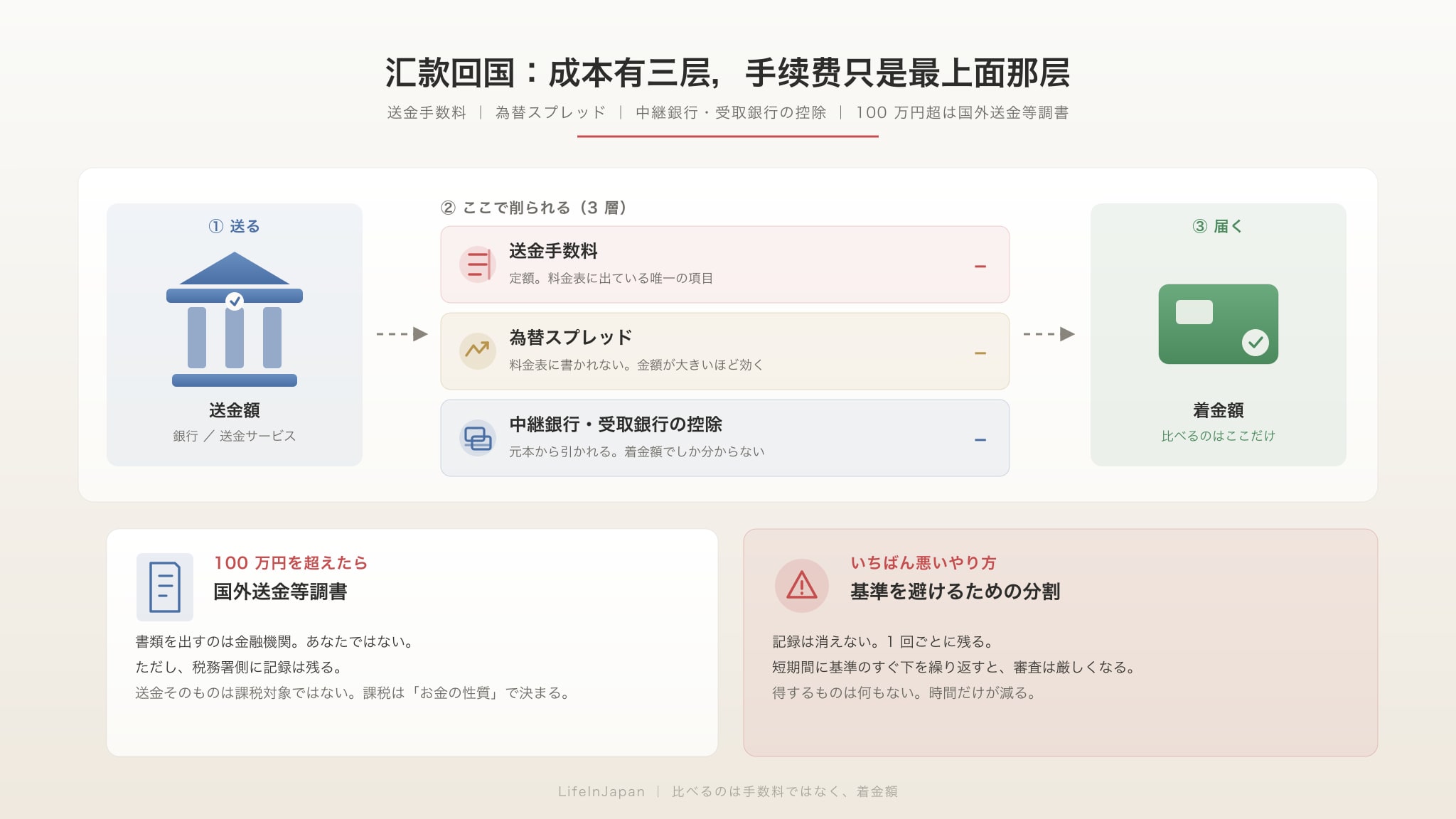
Sending money home from Japan looks like a hunt for the lowest fee. It is not. The cost comes in three layers: the transfer fee, the exchange-rate margin, and what correspondent and receiving banks take out of the principal. Compare only the first and you can lose 2–3% of the amount without ever seeing a line item. There is also a rule people routinely misread: a single overseas transfer over ¥1,000,000 is reported to the tax office by the financial institution — not by you, and not as a tax, but it does mean the transfer exists on paper. This page covers how the money leaves, what it really costs, and which lines not to cross. For opening the account in the first place see banking and mobile; for tax filing generally see filing a tax return.
📅 Verified October 2026Compare on what lands in the recipient's account, not on the fee. Second: for a single transfer above ¥1,000,000 — outbound, and also money received from abroad above that amount — the financial institution must file a 国外送金等調書 with the tax office. You do not fill in a form; the institution does. Third: moving money is not itself a taxable event. Whether tax is due depends on what the money is — salary, business income, a gift, proceeds from selling property. Fourth: splitting a transfer to stay under the threshold is the worst move available. It does not remove the record; it just makes the anti-money-laundering review harder. Fees, limits and required documents differ by provider and route — official guidance is the only number that counts.
💸 Three layers of cost, and the fee is only the top one
| Layer | What it is | Who takes it | How to see it |
|---|---|---|---|
| 1. Transfer fee | A flat charge per transfer; some providers add a percentage | Your bank or remittance service | The only line that is always on the price list — which is why it gets compared and the rest does not |
| 2. Exchange-rate margin | The gap between the rate you are given and the mid-market rate | Bank or service | Usually not on the price list. On larger amounts this layer often costs more than the fee |
| 3. Correspondent and receiving bank charges | An intermediary bank deducts from the principal; the receiving bank may charge for crediting | Intermediary / receiving bank | Only visible in the amount that arrives. Send ¥100,000, receive less, and this is the difference |
| 4. Conversion or withdrawal at the other end | The recipient's own bank converts the currency or charges for a cash pickup | Recipient's bank or payout agent | Not on your statement — ask the recipient |
* The only comparison that holds: same moment, same amount, same payout method, and ask what the recipient actually receives. Specific charges vary by institution — check each provider's published terms.
🏦 Bank or specialist service: it is a structural difference, not a price ranking
| Bank (branch or online) | Specialist remittance service | |
|---|---|---|
| Rate | Its published rate for the day (TTS and similar), typically a wider margin | Close to the market rate, with an explicit fee; the two are usually shown separately |
| Cost shape | Flat fee plus intermediary deductions — what arrives is often less than what you sent | Fee and rate shown together, so the received amount is more predictable |
| Speed | Several business days; weekends and holidays add more | Faster, but still dependent on the receiving bank and the hour you send |
| Payout | Effectively bank account only | Bank account, and with some providers a local wallet or cash pickup — coverage varies by service |
| Limits and paperwork | Large amounts are possible, with identity checks, purpose and source-of-funds questions, and possibly supporting documents | Per-transfer, daily or monthly caps; above them you apply separately or go to a bank |
| Fits | One large transfer, or when you need a bank-issued remittance certificate for a school, landlord or immigration procedure | Regular monthly support payments, small and frequent, or when you want control over timing |
The counter-intuitive part: a specialist service is not automatically cheaper. On small amounts the flat fee dominates, and the specialist usually wins clearly. On large amounts the intermediary deduction shrinks as a share of the total, and a bank quote can come close. Large amounts are also exactly where you need to ask about caps and documents first — many services have a lower ceiling than people assume.
📄 The ¥1,000,000 line: who sees the transfer
This is the part most often explained wrongly. Separate it into three facts:
- The 国外送金等調書 is not your form. When an overseas transfer — outbound, or received from abroad — exceeds ¥1,000,000, the financial institution that handled it files a report with the tax office containing the sender's and recipient's names, addresses and the amount. That is the institution's legal duty. There is no filing step for you.
- It is information, not a tax. A report being filed does not mean you owe anything, and does not mean the transfer is taxable. Its purpose is that the tax office knows a cross-border movement happened and can match it against a return later.
- Whether tax is due depends on the nature of the money. Salary and business income should already be declared. Selling Japanese property, or giving money to family as a gift, follows different rules. The act of transferring creates no income. Treating "transfer" and "taxable" as the same thing is the standard mistake.
There is a separate, much higher threshold: payments or receipts classified as non-trade above ¥3,000,000 require a report to the Bank of Japan under the Foreign Exchange Act. That is a different rule from the tax-office report — do not merge the two. Thresholds and procedures follow official guidance.
⚠️ Never split a transfer to stay under ¥1,000,000
Breaking ¥3,000,000 into four payments, across different providers, over several days, does not make the record disappear: each payment is still reported, and a pattern of payments just under the threshold is itself a red flag in anti-money-laundering review. The practical result is more questions, requests for source-of-funds documents, and possibly a frozen transaction. Splitting buys you nothing and costs you time.
🪪 What a large transfer actually requires
-
Identity document
Residence card, My Number card or passport. At a counter, bring the original. Online, identity was verified when you opened the account. If your period of stay is close to expiring, expect extra questions — that is routine screening of cross-border payments, not a judgement about you.
-
My Number
By law, financial institutions must confirm your individual number for overseas remittance, in both directions. If you have already provided it to that institution you will not be asked again — but if you have not, it gets requested at the worst moment, at the counter, with the transfer form already filled in. Do it in advance.
-
Purpose and source of funds
You will be asked what the money is for and where it came from: living costs, tuition, a gift, property proceeds, accumulated salary. The answer has to match your documents. For larger amounts, expect to show a contract, invoice, withholding slip or bank statement. "I can't quite explain the source" is the most common reason a transfer gets delayed.
-
Recipient details — spelling must match the account exactly
You need the recipient's name in local script and in Latin letters, address, bank name, branch, account number and SWIFT/BIC; some routes also need the receiving bank's address. A mismatch in spelling, spacing, or whether a middle name is included can get the payment returned — and the fee is normally not refunded, so you pay again to resend. For a first transfer to a new recipient, send a small test amount.
📈 Timing: what you can control and what you cannot
- You cannot forecast the rate. No provider knows next week's direction, and waiting months for a better number usually costs more in fees and delay than it saves.
- Do compare on the received amount. Same moment, same amount, ask two providers what the recipient gets. That beats comparing fee percentages.
- Do split over time. A fixed monthly transfer averages out the rate. For anyone living on a salary this is far more realistic than trying to pick a low point.
- Do avoid weekends and long holidays. Margins tend to widen outside business hours and settlement slips. If a payment must arrive by a date — tuition, rent — start a week early.
- Do ask about locking a rate for large amounts. Some banks and services let you fix the rate in advance, at the cost of missing a favourable move. Availability and minimums follow each provider's terms.
❌ Six ways people lose money
- Comparing the fee but not the rate. On small transfers the rate margin frequently exceeds the fee. Saving a few hundred yen on the fee while losing over a thousand on the rate is a very common combination.
- Assuming what you send is what arrives. Intermediary banks deduct from the principal. Ask for the received amount, not the sent amount.
- Recipient name spelled differently. Return, resend, two sets of fees, a week gone. Always test with a small amount first.
- Splitting to avoid the ¥1,000,000 report. See the warning above. This is the one move that makes things strictly worse.
- Remembering after you have left Japan. Card expires, online banking stops, account gets closed — and the money is stuck. Send what needs sending, close what needs closing, before departure.
- Forgetting that the money may need declaring. The transfer is not taxable, but the income that created it might be. Salary, side work and sale proceeds belong in the return for that year.
❓ Common questions
Is sending money to family a gift? Is there gift tax?
Look at the recipient. Japanese gift tax generally applies where the recipient is resident in Japan; if the recipient lives abroad, Japanese gift tax normally does not arise from the transfer. That is not the same as "anything goes": if the recipient is in fact a Japan resident — a family member living here, for instance — the rules differ. And if the money itself is undeclared income, the problem sits in income tax, not gift tax. Individual cases follow the tax office's guidance and official rules. For a large amount, one consultation beforehand is cheaper than fixing it afterwards.
Do app-based services also file the 国外送金等調書?
The filing duty attaches to the financial institution handling the exchange transaction, and does not disappear because you used an app instead of a counter. How any particular provider reports, and in what unit, follows that provider's terms and the official rules — but the safe default is "this transfer will be recorded", not "an app means nobody sees it".
How much can I send in a year before anyone looks?
There is no published annual total that triggers a review; the report turns on whether a single transfer exceeds ¥1,000,000. What draws attention is pattern: several payments just under the threshold in a short window, spread across providers, with changing recipients. Rather than looking for a safe number, make amount, purpose and documents consistent — that is the version of the story that passes.
Can I deduct the transfer fee?
For a private transfer — supporting family, moving your own savings — the fee is generally not deductible. If it is a business payment abroad (stock, contractor fees), the fee can be treated as an expense, because it is directly connected to earning income. Follow the tax office's guidance, and do not relabel a private transfer as a business cost.
What about money coming in from abroad, such as help from parents?
Reverse the direction and you are the recipient, resident in Japan — so it can fall within gift tax (there is an annual basic allowance; the figure follows official guidance). "My parents sent it, so there is nothing to declare" does not follow. Regular support for living costs and a one-off large gift are also assessed differently. General filing rules are in filing a tax return.
Leaving Japan: how does the pension refund fit with sending money out?
The lump-sum withdrawal is applied for after you leave and paid to an account you nominate. So the order is: confirm eligibility and the deadline, keep an account that can still receive money or nominate an overseas one, then finish your departure procedures. Discovering this after the account is closed makes it far more expensive. Conditions, documents and deadlines are in health insurance, pension and the lump-sum withdrawal, and follow the Japan Pension Service's official guidance.
Official sources: NTA — overseas remittance reports ↗ |NTA — filing procedure ↗ |Japanese Bankers Association — My Number ↗ |MOF — Foreign Exchange Act ↗
Next
Banking and mobile in Japan
A working Japanese account is the precondition for all of this: which banks are realistic when you have just arrived, what your period of stay changes, and why a phone number comes first
Read the guide →
Health insurance, pension and leaving Japan
The lump-sum withdrawal is money you can claim back — conditions, deadlines and which account to keep, planned alongside the transfer
Read the guide →
Filing a tax return
The transfer is not taxable, but the income behind it is. When you must file and what to prepare
Read the guide →Money, tax and insurance: the topic index
Eight guides ordered by where you are, from your first payslip to childcare and sending money home