🗂️ Topic: Daily Life (4 guides, in situation order)
Earthquakes and Disaster Prep in Japan: The First Checklist
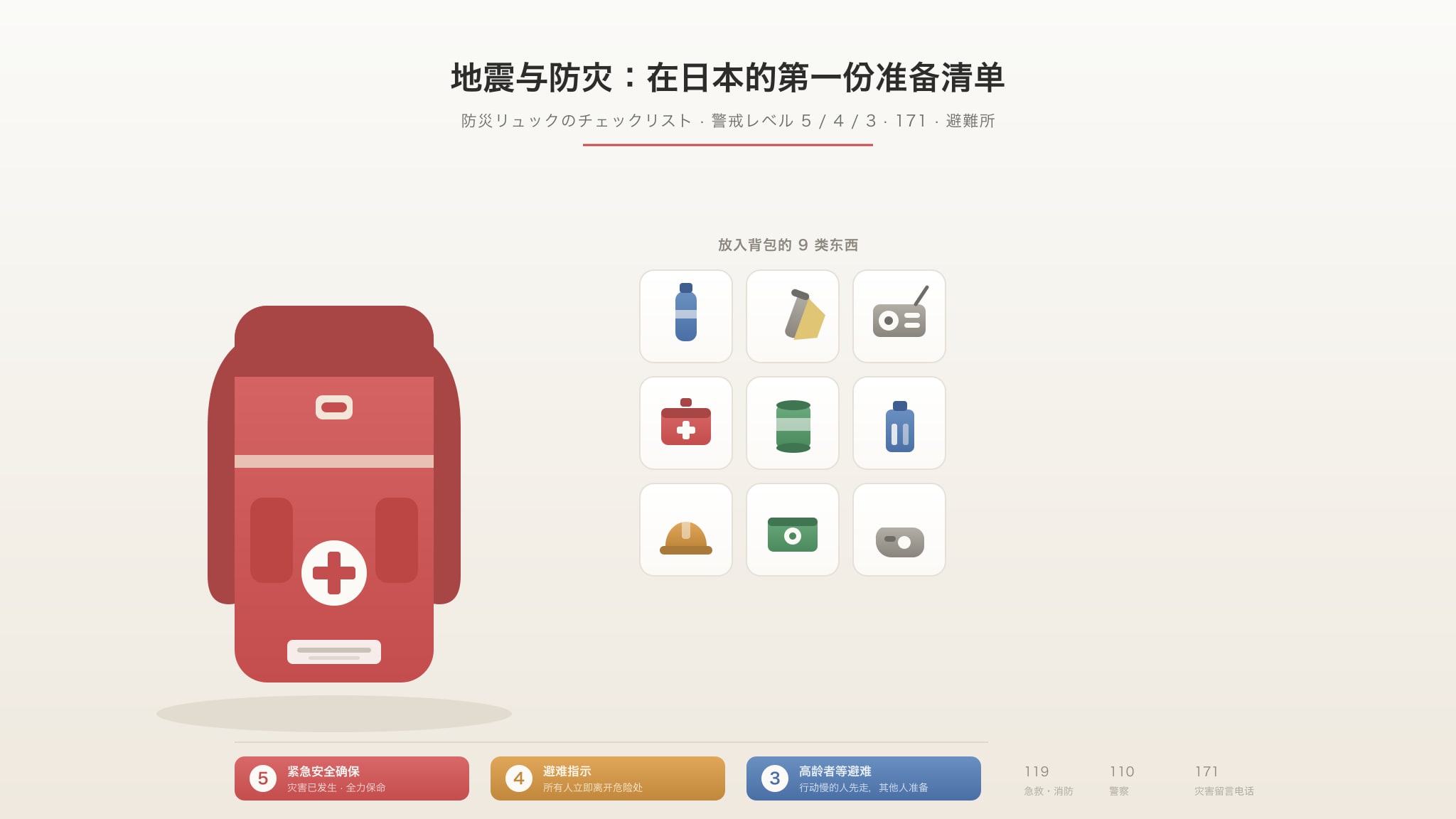
Japan gets earthquakes, typhoons and record rainfall every year. This page is not meant to be read once and forgotten — it is a place for the things you should put in a bag today. The checklist below saves your ticks and can be printed.
Do three things today: ① put three days of water (3 litres per person per day) and food you can eat without heating into one backpack; ② find out where your nearest evacuation site is and how to walk there; ③ memorise 171 (the disaster voicemail service: dial 171, press 1 to record, press 2 to listen). Everything else can wait — but without these three, the first night is rough.
🎒 The go-bag: tick it off and see what is missing
Japanese municipal disaster handbooks separate "what you carry out with you" from "what stays at home to keep you alive for days". This is the carry-out list — the 防災リュック (disaster backpack). Your ticks are saved on this device, so they survive closing the page.
Water and food
Light and information
Medical and hygiene
Identity and money
Clothing and everything else
※ Every household differs: babies need formula and bottles, older relatives need their medication and glasses, pets need food and a carrier. For the list that applies to you, use the disaster handbook issued by your own municipality — it is free at the counter.
⏱️ The first few seconds: what to do depends on where you are
Running during the shaking is the classic fatal mistake. Most injuries come from falling objects and glass, not from buildings collapsing. So the right move depends on where you are when it starts.
-
Indoors: get under a table and hold its leg
Do not run for the door. Shield your head with a cushion or helmet, get under a sturdy table and hold the leg — tables slide. Stay put until the shaking stops.
First thing after it stops: kill any open flame (gas stove, heater), then open a door to make sure the frame has not jammed. Never use the lift.
-
Outdoors: get away from walls, signs and poles
The real dangers are block walls, vending machines, shop signs and glass facades. Cover your head with your hands or bag and move to open ground — a park or square.
Stay away from riverbanks, cliffs and the coast: a tsunami or landslide can follow.
-
In a car: slow down, pull over, stay inside
Do not brake hard — you will be rear-ended. Put your hazards on, slow down and pull to the side, then switch off the engine. Staying in the car is safer while it shakes.
If you have to leave it, keep the keys in the car and the doors unlocked — emergency vehicles may need to move it.
🚨 Warning levels 5 / 4 / 3: when to run and when to wait
Japan's weather and evacuation information uses a five-level scale. Higher is worse, but level 3 does not mean "everyone runs" — getting this wrong means your preparation was wasted.
| Level | Name | What to do |
|---|---|---|
| 5 | Emergency safety measures | Disaster is already happening. Going outside to evacuate is now more dangerous — move to a higher floor or a stronger room inside the building and do whatever keeps you alive. |
| 4 | Evacuation order | Everyone leaves the danger area now. This is the real "go". If getting to a public shelter is itself dangerous, go to a nearby solid building or the safest part of your home. |
| 3 | Evacuation for the slow-moving | Older people, pregnant women, small children and people with disabilities — plus anyone helping them — leave first. Everyone else gets ready to go at any moment. |
| 2 | Heavy rain / flood advisory | Check your hazard map and confirm your route and shelter. |
| 1 | Early warning information | Mental preparation. Check your bag and your information sources. |
※ Levels are issued by your municipality, and criteria differ locally. Do not decide for yourself that an evacuation order is "not that serious yet". Also: shelters are free and open to everyone regardless of nationality.
📻 Where to get information when it happens
171 — the disaster voicemail service
After a large disaster ordinary calls rarely get through. 171 is NTT's disaster message board: dial 171, press 1 to record your own message, press 2 to hear your family's. There is also a web version (web171). Mobile carriers run their own boards too. If you cannot get through, stop redialling and switch to text or the web.
Apps and email alerts on your phone
The single most important thing to sign up for is your municipality's disaster email (防災メール) — it pushes evacuation orders and warning levels straight to you, faster than the news. Add one more for rain and earthquakes: Yahoo! Bousai Sokuhou, the NHK disaster app and NERV are all free. The Japan Meteorological Agency site is the authoritative source, but it is Japanese-only.
NHK and a radio
NHK broadcasts in multiple languages during disasters (English, Chinese, Vietnamese, Portuguese and more). When the power and the network are both down, a battery radio is the only channel left — which is why it is on the list.
🏫 Evacuation sites: find yours now, not later
Shelters are usually school gyms, community halls and civic centres. They are free and open to any nationality. Looking for one during the disaster is too late — do these three things now:
-
Find your shelter and your route
Get the hazard map (ハザードマップ) from your municipal website or counter. It shows predicted flood depth, landslide zones and shelter locations for your address. Then walk the route once — maps make many routes look shorter than they are.
-
Know the difference between a meeting point and a shelter
Different hazards mean different destinations: floods send you to high ground, earthquakes to a structurally safe building. Some municipalities gather people at a temporary assembly point first. Your local handbook is the authority.
-
Tell one reachable person where you will be
Leave a message on 171 and tell family or friends which shelter you are heading to. Also write down your embassy or consulate and your family abroad — during a disaster, calls from outside the country often connect when local calls do not.
⚠️ Five things foreign residents get wrong
- Waiting to be told, because you do not read Japanese. The main channels — municipal disaster email, city websites, the neighbourhood circular — are in Japanese. Turn on NHK's multilingual broadcasts, or ask a colleague or your landlord to help you subscribe to the local disaster email.
- Thinking foreigners cannot use shelters. They can. Shelters do not check nationality or residence status, and you do not need your residence card to get in.
- Stocking water but no cash. When the power fails, card readers stop and public phones take coins only. Break your emergency cash into small denominations.
- Not securing your furniture. Far more earthquake injuries come from falling bookcases and TV cabinets than from buildings collapsing. Strap tall furniture to the wall and apply shatter film to glass now — both cost a few hundred yen at a home centre or hundred-yen shop.
- Assuming danger only means the coast. Inland areas get landslides and flash flooding too. Do not conclude you are safe because you are far from the sea — read your own hazard map first.
🏛️ Shelters, disaster emails and handbooks all come from your municipality
Find out where your city office counter is and what it handles — damage certificates and insurance relief are issued at the same counter
❓ Common questions
Three days or seven days of supplies?
Most municipal handbooks say at least three days, and many recommend preparing for a week. Three days is the floor while you wait for rescue; a week is the realistic gap before logistics recover. Three litres a day for seven days is 21 litres per person — that will not fit in a backpack. The usual answer: three days in the bag you carry out, and a further store at home to cover a week, kept somewhere sensible and with the dates checked.
What is different in an apartment or high-rise?
Three things: ① the lifts will stop — never use one after a quake, and keep slippers and a flashlight by the door. ② Upper floors sway more and for longer — securing furniture matters more, not less. ③ Doors can jam — check your front door opens right after the shaking, not when you are trying to leave.
Power, water and gas have gone off. Now what?
First check whether it is the whole block (radio, neighbours). If the power is out, unplug appliances so they do not cause a fire when it returns. If the gas is out, confirm the mains and all burners are off, and have it checked before relighting. If the water is out, do not leave taps open — you will flood the room when it comes back. For connection and disconnection procedures, see the utilities guide.
Can I evacuate by car?
In principle, go on foot. Cars cause congestion, block emergency vehicles and can be trapped. If you genuinely need one (a family member needing care, a shelter far away), confirm the designated route in your local handbook and leave the keys in the car so it can be moved.
Can I bring my pet to a shelter?
Most public shelters do not accept pets (assistance dogs excepted). More municipalities now designate separate areas or shelters for "evacuation with pets", but places are limited. Check your municipality's rules first and prepare a carrier, pet food and a copy of the vaccination record.
Official sources: Cabinet Office — Disaster Prevention ↗ |Japan Meteorological Agency ↗ |Fire and Disaster Management Agency ↗
Next steps
City office guide
Disaster emails, hazard maps and handbooks all come from your municipality — and so do damage certificates after an event
Read the guide →
Setting up and stopping utilities
What to do about power, water and gas during a disaster, and what to watch for when they come back
Read the guide →