🗂️ Topic: Status & Visas (6 guides, in situation order)
Working Part-Time in Japan: The Work Permit and the 28-Hour Cap
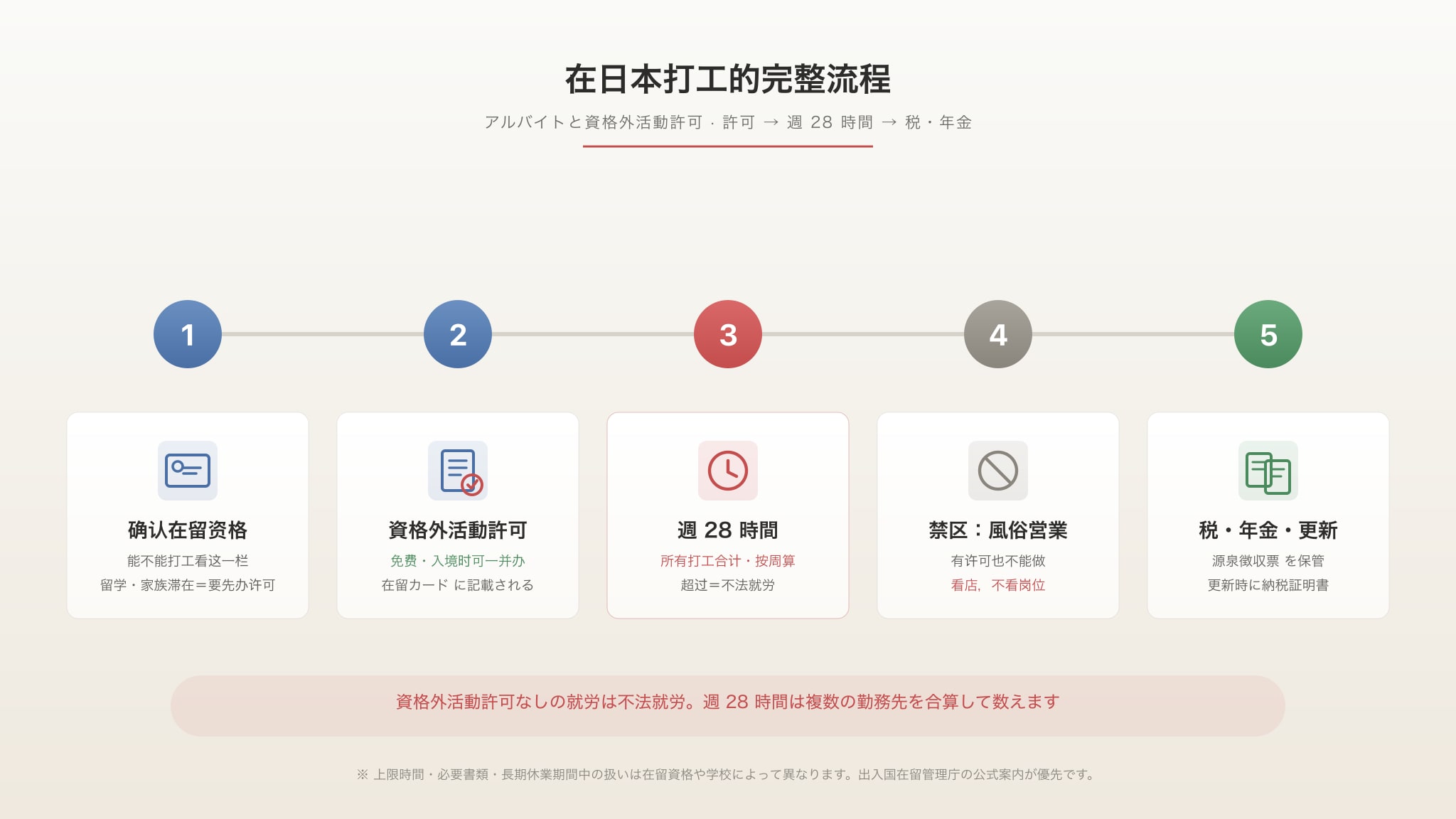
Working part-time in Japan is not simply a matter of finding a shift: most statuses of residence require a permission to engage in activity other than that permitted (shikakugai katsudō kyoka) first, that permission comes with a weekly cap, and there is a category of workplace you may not work in even with permission. This page walks the whole chain in order: check your status → get the permission → count the hours → clear the banned workplaces → sort out tax and pension → close things out when you quit or renew.
📅 Verified October 2026Start with your status of residence. If you hold a status that does not permit work — "Student" (留学), "Dependent" (家族滞在) and similar — you must obtain the permission to engage in activity other than that permitted before you take any paid work. It is free of charge, and for many people it can be granted at the airport when you enter Japan (that is the small print on the back of your Residence Card). Once you hold it, a student's limit is 28 hours per week in total across all jobs — the cap applies to the sum, not to each employer separately; during the long vacation periods defined in your school calendar the daily limit is relaxed, but the exact terms are set by official guidance. And adult-entertainment businesses and related establishments are off limits even with permission — that is the single most dangerous line. Two things people forget: part-time income feeds into tax dependent status and residence tax, and residence-status renewals commonly require tax payment certificates, so unresolved tax can block a renewal outright.
📋 At a glance: can your status work?
| Status of residence | Can you work? | What matters |
|---|---|---|
| Student (留学) | Yes, with permission | 28 hours per week in total; the long-vacation rule is different (check official guidance) |
| Dependent (家族滞在) | Yes, with permission | Also 28 hours per week; no long-vacation relaxation |
| Work statuses (Engineer/Specialist in Humanities/Int'l Services, etc.) | No | You may only do the activity your status covers — anything else is unauthorised activity |
| Specified Activities (特定活動) e.g. working holiday | Depends on the individual permission | Your permit states whether and how much you may work — follow the permit and official guidance |
| Permanent Resident, Long-Term Resident, Spouse of a Japanese national | Yes, no hour cap | No work restriction as such, but the adult-entertainment ban still applies |
| Temporary Visitor | No | Working on a tourist or sightseeing entry is illegal |
* There are dozens of statuses; only the most common are listed. What your own status allows is determined by your Residence Card and by official guidance from the Immigration Services Agency.
🧭 From zero to your first shift: 7 steps
-
Read your Residence Card first
Everything downstream depends on one question: does your status of residence permit work at all? The "Status of Residence" field on your card answers it — no guessing required.
- Statuses that do not permit work (Student, Dependent, Temporary Visitor): you need the permission first.
- Statuses that do permit work (Engineer/Specialist in Humanities, Permanent Resident): no permission needed, but you may only do the activity your status covers — and you still cannot work in adult entertainment.
Check your period of stay too: the permission normally runs for the same period as your status, so after a renewal, confirm the permission moved with it.
-
Apply for the permission to engage in other activity
Apply at the immigration office with jurisdiction over where you live. There is no fee. The usual documents are the application form, your Residence Card and your passport; students are typically also asked for a certificate of enrolment or a school-issued document (the exact list follows official guidance). Postal applications exist, and some schools submit on students' behalf — asking your international student office is the fastest route.
The easiest path is to apply on arrival: submit the request together with your landing permission at the airport and it will show on your Residence Card. If you have already entered without it, you can still apply at the immigration office afterwards.
Note the two kinds: a blanket permission allows you to work in general (this is what most students hold), while an individual permission approves one specific activity. The 28-hour rule below is the blanket-permission rule.
-
Work out how the weekly cap actually counts
This is where most problems start. Three things to internalise:
- It is a total, not a per-employer cap. A convenience store at 20 hours plus an izakaya at 15 hours is 35 hours a week — already over the limit. The cap is not shared out between employers, and "they don't know about each other" is not a defence.
- It is counted weekly. Which day starts the week is handled by ordinary practice, but the details follow official guidance. When you plan shifts across a boundary, make sure you are not stacking both sides into one week.
- Long vacations have their own rule. During the long holiday periods in the school calendar, the daily limit for students is relaxed — but how far, and under what conditions, is set by official guidance. Do not read it as "anything goes in summer". Dependents get no such relaxation.
The safest habit: keep your own record of weekly hours. If questions are ever asked, having your own log line up with the employer's rota is the strongest thing you can produce.
-
Rule out the banned workplaces before you interview
There is a category of establishment where you may not work regardless of your status and regardless of permission: adult-entertainment businesses and related operations. Typical examples include hostess bars (キャバクラ), snack bars, lounges, pachinko parlours and adult shops. The test is whether the establishment falls under the entertainment-business law — follow official guidance.
What makes this dangerous is that the job itself often looks innocent — waiting tables, working the till. The test is the venue, not the task.
Also watch for: gambling-related work involving customers, unlicensed transport or driving jobs, and tasks reserved for a professional licence. If you are unsure, ask your school's international office or an immigration consultation desk before your first shift, not after.
-
What to hand over at the start — and what a real employer checks
A compliant employer will carry out a status check: photocopy your Residence Card, confirm you hold the permission, and note your period of stay. That is the employer's legal duty and it is also your protection — if a shop never looks at your Residence Card, that shop is itself a risk.
Other common items: a Japanese bank account for wages, your My Number for payroll and tax filings, and a CV. Some employers want a student ID or will only schedule shifts on the basis that you are a student.
Ask three questions on day one: how the rota is set, when wages are paid, and whether your hours are being tracked against the cap. That last one matters because overworking is your responsibility — "the manager asked me to stay longer" does not transfer it.
-
Tax and pension: what part-time work triggers
Part-time income is not just money in hand; it feeds three separate sets of rules:
- Tax: above a certain income you may need to file a tax return; if a family member claims you as a dependent for tax purposes, your income can affect that claim. The thresholds are set by official guidance — do not copy old figures off the internet.
- Social insurance: above certain hours and income, your employer may have to enrol you in employee social insurance. Whether you qualify, and at what threshold, follows official guidance, and the rules differ by company size.
- Pension: from age 20, residents of Japan are in principle covered by the National Pension. Students can apply for the student payment exemption, which has its own application and income conditions (see official guidance).
Practical advice: keep every withholding slip (源泉徴収票) and tax certificate (課税証明書). Renewals ask for them, and chasing replacements at the last minute is painful.
-
When you quit, and when you renew
When you quit: collect your withholding slip (wages and tax withheld for the year), confirm your final wages and hours, and if the job came with employment insurance, get the relevant separation documents. Also confirm that any social insurance withdrawal has actually been processed — do not leave it as "I assumed it was cancelled".
When you renew: immigration looks at your conduct as a resident — whether you respected the hour cap and whether you have paid what you owe. Get your tax payment and tax assessment certificates ready beforehand and review your own hours. A pattern of overwork that surfaces during review affects the outcome directly.
💡 First, what does your status actually allow?
If you are not sure which category your status falls into, work through the status check before deciding on a work permit
⏰ Three myths about the weekly cap
- Myth 1: "28 hours per employer is fine." No — it is 28 hours across everything. This is checked closely, and multiple employers are an easy way to break it without noticing.
- Myth 2: "Vacations are unlimited." Not accurate. The cap is relaxed during long holidays, but by how much, and under which conditions, is set by official guidance; the moment term starts again, the ordinary rule is back.
- Myth 3: "Going slightly over is harmless." The risk is not being caught on the day — it is that the record stays. Renewals and future applications look at your past activity. A year you got away with it can cost you the year you need to stay.
⚠️ Three ways part-time work goes badly wrong
① Starting work without the permission. That is unauthorised employment, and the consequences go well beyond losing the job — your status itself can be affected, and in serious cases you can be removed from Japan. Get the permission first, then look for work. ② The workplace is an adult-entertainment business. Even if you only work the till, even if the manager says it is fine, working at such a venue is unauthorised activity. Establish what kind of business it is before you interview. ③ Adding a second job without re-adding the hours. "It is only a few weekend hours" is exactly how people cross the line. Every time you add a job, total all your hours again.
🚫 Off limits: what you cannot do at all
| Category | Why it is out |
|---|---|
| Adult-entertainment and related businesses and associated establishments | Closed to every status and every permission; what you would be doing there is irrelevant |
| Any paid work on a Temporary Visitor status | That status carries no work permission, and there is no permit to apply for |
| Work statuses doing work outside the status | E.g. an Engineer/Specialist status holder doing manual labour — that is activity outside the status |
| Tasks reserved for a professional licence | Medical acts without a licence, commercial driving without the required permit, etc. |
| Unpaid or token-paid "helping out" or "internships" | Whether something counts as work depends on substance, not the label — individual cases follow official guidance and consultation desks |
* This is a framework, not an exhaustive list. For anything unclear, confirm with your school's international office or an immigration consultation desk before you start.
📝 Pre-work checklist
- Check the status and period of stay on your Residence Card
- If your status needs it: the permission is granted (visible on your Residence Card)
- Know which you hold: a blanket or an individual permission, and what it says
- Add up weekly hours across all your jobs and confirm you are under the cap
- Confirm at interview that the venue is not an adult-entertainment related business
- Hand over your Residence Card copy etc. at the start, and keep your own hours log
- Note your payday and when your withholding slip arrives
- On leaving: collect your withholding slip and insurance documents
- Before renewing: prepare your tax payment and tax assessment certificates
❓ Common questions
I entered without the permission — can I still apply?
Yes. Apply for the permission at the immigration office with jurisdiction over where you live. There is no fee. You will normally need your Residence Card, passport and the application form, plus a certificate of enrolment if you are a student (follow official guidance). Do not start working while the application is pending — "I have already applied" is not a basis to begin.
Does the permission expire? Do I re-apply after renewing my status?
A blanket permission normally runs with your period of stay, so renewing your status carries it forward and you do not re-apply each time. But if the renewal changes what status you hold — say from Student to a work status — the situation changes: a work status does not need this permission, and equally you can no longer do activity outside it. Transition periods are where mistakes happen, so follow the permit and official guidance, and ask immigration if in doubt.
What happens if I am found to have worked over the cap?
Two layers. The activity itself is unlawful, which can lead to action against your status. And it affects later reviews: when you renew or apply for another status, your past activity is part of the assessment. In practice, the more common outcome is not a penalty on the spot but a renewal that gets held up over it. So "I was never caught" is not the same as "there is no problem".
Can my family still claim me as a dependent?
Your income can affect that. There is an income threshold for being claimed as a tax dependent, and above it the family member's claim is affected; you may also need to file your own tax return. There is separately a social-insurance dependency test with a different threshold. The thresholds follow official guidance and change with tax reform, so do not plan around figures you read online.
Will part-time work affect a future switch to a work status?
It can, mainly through the conduct as a resident angle. Respecting the hour cap and paying what you owe are part of the material reviewed. Clean part-time work counts in your favour; overwork and unpaid tax count against you. If you plan to stay in Japan long-term, start keeping hour logs and tax documents from your first job — it costs almost nothing and pays off.
Official sources: Immigration Services Agency (permission to engage in other activity) ↗ |Immigration Services Agency (about the permission) ↗ |Japan Pension Service (student exemption) ↗
Next
Residence status guide
Not sure what your status allows, or whether you need to change it? Run the check first, then decide about a work permit
See the guide →
National Health Insurance and Pension
If your employer does not enrol you, you handle health insurance and pension yourself — and you can claim part of your pension back when you leave Japan
See the guide →